The softening tone of the economic data in recent weeks has turned the spotlight to the issue of what additional action the Fed may need to take to provide new fuel to the underwhelming economic recovery. This emerging debate was also highlighted in yesterday's front page Wall Street Journal article (http://online.wsj.com/article/SB10001424052748703834604575365052129874156.html?KEYWORDS=The+Fed+Sees+Slower+Growth)
as well as in the release of the minutes of the June 22-23 FOMC meeting (http://www.federalreserve.gov/monetarypolicy/fomcminutes20100623.htm).
Although the Fed's conclusion at the late June meeting was that no additional measures were deemed necessary at that point, the ongoing weakness in the economic data- showcased again in this morning's disappointing Philly Fed and Empire Fed manufacturing surveys for July- is likely to keep the debate alive and probably intensify it.
A discussion as to what further action the Fed can take to reinvigorate the recovery is understandable but based on the premise that monetary policy-making does indeed have the power, or leeway, to achieve that goal in the current environment. With the federal funds rate close to zero and an enormous amount of liquidity slashing around in the the financial system, this is not so obvious.
The Fed has seemingly exhausted the array of the most potent tools it possesses to promote economic growth, that is short-term rates and quantitative easing. In fact the entire structure of interest rates remains extremely growth-friendly, with not only Treasury yields near record-lows but also with credit spreads at historically tight levels. The economic recovery's inability to inspire great confidence, nearly a year after its onset, is not the result of market yields that are not low enough or the financial system having inadequate liquidity. It is mostly the result of a lengthy healing process following a devastating financial crisis and recession that is preventing the low interest rates and abundant liquidity from having a more textbook-like stimulative effect on economic activity.
It would simply not be credible to argue that the Fed's facilitating of another 7 to 10 basis points decline in the federal funds rate form its recent 17 to 20 basis point average would have any effect on the economy at this point. Similarly, injecting more liquidity via the resurrection of some of the special temporary liquidity facilities that were put in place after the Lehman affair and were winded down by the beginning of this year would do nothing to promote economic activity, as those facilities were largely meant to stabilize a financial system on the brink of collapse and offset a disastrous liquidity squeeze in the aftermath of Lehman. The financial system is currently swimming in liquidity and it is far from clear that the doubling of the LIBOR rate since the beginning of the year is an issue that can be addressed with more liquidity injection by the Fed via such temporary facilities.
Against this backdrop the only possible remaining course of action for the Fed would be the resumption of the Fed's program of asset purchases, which ended in March. The objective would presumably be to help bring market yields lower, both in the Treasury and MBS markets, which would help provide a boost to the economic recovery. Appealing as this avenue may appear at first, a less impulsive, facts-based, examination of its implications raises some caution flags.
The Fed's staff has reportedly conducted some studies showing that the central bank's asset purchase program- which has led to an increase in its balance sheet by $1.5 trillion today compared to before the financial crisis- may have lowered market yield by as much as 50 basis points. The precision of those studies usually leaving a lot to be desired, and given that a 50 basis point estimate was presented as an upper limit, it is probably more realistic to assume that the effect of the Fed's asset purchases on long term yields has been somewhat smaller.
Both long-term Treasury yields and mortgage rates are lower today compared to the prevailing ones at the time when Treasury purchases and MBS purchases by the Fed ended (in October 2009 and March 2010 respectively). In the meantime, the momentum of the economic recovery has slowed. Arguing that the Fed's possible resumption of an asset purchases program could engineer another 20 to 30 basis point decline in yields that would prove to be materially helpful to economic activity is a highly questionable proposition. Besides, the idea of the Fed embarking on another massive program of asset purchases that would increase its portfolio by another $500 to $800 billion suffers from a cost-effectiveness problem. Such an additional increase in the Fed's balance sheet would complicate enormously further the Fed's ultimate exit strategy, given the bigger amount of liquidity to be absorbed at that time.
If the pace of the economic recovery slows to a disconcerting degree ahead, the Fed may be under extreme pressure to show that it is responding by taking some action and perhaps resume some asset purchases. In reality, though, the economic recovery is not suffering from interest rates that are not low enough or from a banking system that is not liquid enough and this calls into question the true effectiveness of any such action. Inasmuch as the Fed is often perceived as powerful enough to manipulate economic growth at will, the effectiveness of monetary policy is seriously compromised in the midst of circumstances like the current ones. Japan has already found that out.
Anthony Karydakis
Thursday, July 15, 2010


Wednesday, July 14, 2010
Retail Sales+Trade Deficit=Lower Q2 GDP
The widening of the May trade deficit by $2.0 billion to $42.3 billion yesterday (both in nominal and real terms- the latter being the key to GDP calculations) and the somewhat disappointing retail sales for June this morning, both point to an appreciably lower Q2 GDP than previously expected.
As a result of the May trade deficit number, net exports are now expected to be a bigger drag on Q2 growth than previously thought, probably to the tune of $50 billion, subtracting more than 1 1/2 percentage point from GDP. This would be almost double the 0.83 percent net exports had subtracted from Q1 GDP growth.
In terms of the June retail sales, overall sales fell 0.5%, largely due to a 2.3% decline in vehicle sales. Excluding autos, sales were off by a more modest 0.1%. The part of the retail sales report that is most directly relevant to GDP calculations- that is, total sales less autos/gas station/building materials- was up 0.2% for the month, following a 0.1% decline in May.
These numbers are consistent with personal consumption in the 2 1/4-2 1/2% range in the second quarter, below the first quarter's 3.0% annual rate.
The net-net of these two reports is that Q2 GDP growth now looks more like a 2.5% proposition, with the pace of inventory accumulation remaining the wild card, given the limited inventory data available to date. Such a pace of growth would follow a twice-downward revised 2.7% Q1 GDP, confirming the disappointing failure of the recovery to pick up any momentum in the spring months from an already unimpressive first quarter.
Still, moving forward, a gradual- albeit, frustratingly slow- acceleration in employment growth should help sustain an improvement in income growth and consumption in the second half of the year, that would lead to a rebalancing of the growth trajectory to the 3.0-3.5% range. In fact, the seeds of this likely trend were evident in the May trade deficit data, as well in the ongoing deterioration of the international trade picture in recent months, as imports rose by a healthy 2.9%, reflecting the unfolding strengthening in consumer spending.
Anthony Karydakis
As a result of the May trade deficit number, net exports are now expected to be a bigger drag on Q2 growth than previously thought, probably to the tune of $50 billion, subtracting more than 1 1/2 percentage point from GDP. This would be almost double the 0.83 percent net exports had subtracted from Q1 GDP growth.
In terms of the June retail sales, overall sales fell 0.5%, largely due to a 2.3% decline in vehicle sales. Excluding autos, sales were off by a more modest 0.1%. The part of the retail sales report that is most directly relevant to GDP calculations- that is, total sales less autos/gas station/building materials- was up 0.2% for the month, following a 0.1% decline in May.
These numbers are consistent with personal consumption in the 2 1/4-2 1/2% range in the second quarter, below the first quarter's 3.0% annual rate.
The net-net of these two reports is that Q2 GDP growth now looks more like a 2.5% proposition, with the pace of inventory accumulation remaining the wild card, given the limited inventory data available to date. Such a pace of growth would follow a twice-downward revised 2.7% Q1 GDP, confirming the disappointing failure of the recovery to pick up any momentum in the spring months from an already unimpressive first quarter.
Still, moving forward, a gradual- albeit, frustratingly slow- acceleration in employment growth should help sustain an improvement in income growth and consumption in the second half of the year, that would lead to a rebalancing of the growth trajectory to the 3.0-3.5% range. In fact, the seeds of this likely trend were evident in the May trade deficit data, as well in the ongoing deterioration of the international trade picture in recent months, as imports rose by a healthy 2.9%, reflecting the unfolding strengthening in consumer spending.
Anthony Karydakis
Monday, July 12, 2010
The Questionable Premise of the TIPS Market
Since the height of the sovereign debt turmoil that rocked Europe in mid-May, inflation-indexed Treasury securities (TIPS) have underperformed nominal Treasuries by a wide margin. As a result, the yield spread between the latter and TIPS for 10-year maturities (breakeven) has narrowed by about 50 basis points from its average (and close to its normal trend) of 230 basis points in the first four months of the year.

Source: Federal Reserve Board
The reason for the significant concession that the TIPS market has offered in the last eight weeks is a fairly straightforward one. The fiscal crunch that is affecting many European countries (including the non-eurozone U.K) has been widely perceived as a major headwind that is likely to affect adversely the growth prospects in the U.S. over the medium-term. As a result, the already unimpressive growth trajectory of the economic recovery is being downgraded, as is the already tame inflation outlook.
With core CPI already below 1.0% (0.9% year-on-year) and overall inflation steadily drifting lower (currently at 2.0% year-on-year), the expectation is that the renewed weakness in the economic outlook is likely to cause a further downward drift in both inflation measures ahead- with the behavior of the overall CPI being the relevant index for the pricing of TIPS. The term "disinflation" has increased in popular use recently, while, talk of a double-dip recession and an outright deflation has resurfaced more pointedly. Against that background, the primary appeal of TIPS (that is, to offer protection against inflation over the maturity of the security) naturally dissipates, which accounts for the narrowing of the breakevens.
Although there is little doubt that the recovery has experienced a modest loss of momentum in the last couple of months, the risks ahead have been somewhat exaggerated. The fiscal situation in Europe is already being addressed with reasonably credible measures, and, in any event, any moderation in growth there (still not a foregone conclusion, given the latest data coming out of Germany that suggest that growth is the biggest eurozone economy is still moving forward) is offset by a solid rebound in the emerging market economies. Furthermore, economic recoveries- particularly of the relatively halting kind, like the one in the U.S currently- are known for hitting an occasional soft patch, which is not in and of itself alarming. Lastly, the notion that an economic recovery will just roll over and fizzle, triggering a double-dip, has been generally not supported by history (see, http://economistscorner.blogspot.com/2009/09/do-double-dip-recessions-really-happen_09.html)
On some level, the premise upon which TIPS have underperformed Treasuries recently is almost undesrtandable, but, nonetheless, likely flawed. Although the narrowing of the bearkevens may, in view of an upcoming 30-year TIPS auction next month and the possibility of more softness in the economic data over the near-term, persist for a while longer, it remains particularly vulnerable to evidence that, all things considered, the U.S. economic recovery remains largely on track. Therefore, a trading bet on the restoration of more normal breakeven levels in the 10-year sector over the next few months merits consideration.
Anthony Karydakis

Source: Federal Reserve Board
The reason for the significant concession that the TIPS market has offered in the last eight weeks is a fairly straightforward one. The fiscal crunch that is affecting many European countries (including the non-eurozone U.K) has been widely perceived as a major headwind that is likely to affect adversely the growth prospects in the U.S. over the medium-term. As a result, the already unimpressive growth trajectory of the economic recovery is being downgraded, as is the already tame inflation outlook.
With core CPI already below 1.0% (0.9% year-on-year) and overall inflation steadily drifting lower (currently at 2.0% year-on-year), the expectation is that the renewed weakness in the economic outlook is likely to cause a further downward drift in both inflation measures ahead- with the behavior of the overall CPI being the relevant index for the pricing of TIPS. The term "disinflation" has increased in popular use recently, while, talk of a double-dip recession and an outright deflation has resurfaced more pointedly. Against that background, the primary appeal of TIPS (that is, to offer protection against inflation over the maturity of the security) naturally dissipates, which accounts for the narrowing of the breakevens.
Although there is little doubt that the recovery has experienced a modest loss of momentum in the last couple of months, the risks ahead have been somewhat exaggerated. The fiscal situation in Europe is already being addressed with reasonably credible measures, and, in any event, any moderation in growth there (still not a foregone conclusion, given the latest data coming out of Germany that suggest that growth is the biggest eurozone economy is still moving forward) is offset by a solid rebound in the emerging market economies. Furthermore, economic recoveries- particularly of the relatively halting kind, like the one in the U.S currently- are known for hitting an occasional soft patch, which is not in and of itself alarming. Lastly, the notion that an economic recovery will just roll over and fizzle, triggering a double-dip, has been generally not supported by history (see, http://economistscorner.blogspot.com/2009/09/do-double-dip-recessions-really-happen_09.html)
On some level, the premise upon which TIPS have underperformed Treasuries recently is almost undesrtandable, but, nonetheless, likely flawed. Although the narrowing of the bearkevens may, in view of an upcoming 30-year TIPS auction next month and the possibility of more softness in the economic data over the near-term, persist for a while longer, it remains particularly vulnerable to evidence that, all things considered, the U.S. economic recovery remains largely on track. Therefore, a trading bet on the restoration of more normal breakeven levels in the 10-year sector over the next few months merits consideration.
Anthony Karydakis
Thursday, July 8, 2010
The IMF's More Sanguine Take on Global Growth
Despite widespread uneasiness recently about the prospects for economic activity in the U.S. and Europe, the IMF's latest forecast that was released this morning paints a noticeably more sanguine picture for global growth, both in 2010 and 2011.
http://www.imf.org/external/pubs/ft/survey/so/2010/RES070710A.htm
The IMF has now revised its 2010 growth estimate for the group of the so-called "advanced economies" (which does not include China or India) to 2.6%- up 0.3% from its previous estimate in April. Next year's growth forecast for those countries has been left unchanged at 2.4%.
Within the group of the "advanced economies", U.S. GDP growth has now been revised higher to 3.3% for this year (from 3.1% previously) and 2.9% in 2011 (from 2.6% before). The Japanese economy is now expected to grow by 2.4% this year (versus an earlier estimate of 1.9%), while a modestly slower pace expected in 2011 (1.8% now, compared to 2.0% before). As a whole, the growth forecast for the eurozone bloc has remained unchanged at 1.0% for this year but has been downgraded by 0.2% to 1.3% for 2011.

The basic tenor of the revised forecasts consists of a small upward revision to this year's global growth, and little overall change to next year's expected growth. However, the detailed country-by-country estimates now show a marginal softening in economic activity in most of the "advanced economies" in 2011, which is offset by a moderate upward revision to the growth estimate for the U.S. next year.
The GDP growth forecast for Asian has now been revised upward to 7 1/2% this year from 7% previously, as a result of the inventory cycles and "continued buoyancy in exports and private domestic demand", while there is no change to next year's previously published forecast for a more moderate and sustainable growth rate of about 6%.
Taken literally, the IMF's upward revisions to this year's growth forecasts, and the fairly minimal downward revisions for most countries in 2011, are counter-intuitive. They seem to run contrary to the recent perception of considerably elevated risks to global growth due to the fiscal turmoil in Europe and an ensuing wave of fiscal austerity.
There are two key elements here that can help reconcile this apparent inconsistency. a) The IMF explicitly acknowledges in its report the "markedly" escalated risks to growth ahead, stemming from the financial stress associated with the sovereign debt situation and the policy response to it. At the same time, it appears that, in formulating the revised forecasts, the IMF's operating assumption is that those challenges can still be contained reasonably well without chocking growth. In other words, it views those headwinds to growth as remaining still in the sphere of a "risk" rather than having already taken a central role in driving growth ahead or having over-run the natural growth dynamics already in place. b) Economic forecasts are, to a considerable extent, a "dry" (and highly imperfect at that) exercise, where assumptions are used as inputs and "results" are automatically generated in the form of point estimates. Revisions to the tune of 0.2%, 0.3%, or even 0.5% practically represent something less than a rounding error- therefore, their true reliability needs to be viewed with a grain of salt.
Perhaps, the key message from the IMF's revised forecasts is that, headline-grabbing as they have been lately- the sovereign market situation and fiscal policy developments should be monitored closely but not considered yet as a defining factor already shaping the growth trajectory ahead.
Anthony Karydakis
http://www.imf.org/external/pubs/ft/survey/so/2010/RES070710A.htm
The IMF has now revised its 2010 growth estimate for the group of the so-called "advanced economies" (which does not include China or India) to 2.6%- up 0.3% from its previous estimate in April. Next year's growth forecast for those countries has been left unchanged at 2.4%.
Within the group of the "advanced economies", U.S. GDP growth has now been revised higher to 3.3% for this year (from 3.1% previously) and 2.9% in 2011 (from 2.6% before). The Japanese economy is now expected to grow by 2.4% this year (versus an earlier estimate of 1.9%), while a modestly slower pace expected in 2011 (1.8% now, compared to 2.0% before). As a whole, the growth forecast for the eurozone bloc has remained unchanged at 1.0% for this year but has been downgraded by 0.2% to 1.3% for 2011.

The basic tenor of the revised forecasts consists of a small upward revision to this year's global growth, and little overall change to next year's expected growth. However, the detailed country-by-country estimates now show a marginal softening in economic activity in most of the "advanced economies" in 2011, which is offset by a moderate upward revision to the growth estimate for the U.S. next year.
The GDP growth forecast for Asian has now been revised upward to 7 1/2% this year from 7% previously, as a result of the inventory cycles and "continued buoyancy in exports and private domestic demand", while there is no change to next year's previously published forecast for a more moderate and sustainable growth rate of about 6%.
Taken literally, the IMF's upward revisions to this year's growth forecasts, and the fairly minimal downward revisions for most countries in 2011, are counter-intuitive. They seem to run contrary to the recent perception of considerably elevated risks to global growth due to the fiscal turmoil in Europe and an ensuing wave of fiscal austerity.
There are two key elements here that can help reconcile this apparent inconsistency. a) The IMF explicitly acknowledges in its report the "markedly" escalated risks to growth ahead, stemming from the financial stress associated with the sovereign debt situation and the policy response to it. At the same time, it appears that, in formulating the revised forecasts, the IMF's operating assumption is that those challenges can still be contained reasonably well without chocking growth. In other words, it views those headwinds to growth as remaining still in the sphere of a "risk" rather than having already taken a central role in driving growth ahead or having over-run the natural growth dynamics already in place. b) Economic forecasts are, to a considerable extent, a "dry" (and highly imperfect at that) exercise, where assumptions are used as inputs and "results" are automatically generated in the form of point estimates. Revisions to the tune of 0.2%, 0.3%, or even 0.5% practically represent something less than a rounding error- therefore, their true reliability needs to be viewed with a grain of salt.
Perhaps, the key message from the IMF's revised forecasts is that, headline-grabbing as they have been lately- the sovereign market situation and fiscal policy developments should be monitored closely but not considered yet as a defining factor already shaping the growth trajectory ahead.
Anthony Karydakis
Wednesday, July 7, 2010
The Multiple Faces of the "Exit Strategy"
The term "exit strategy" has become one of the most popular in the financial lexicon over the last year or so, following the unprecedented amount of liquidity injected into the system by the Fed in the midst of the financial crisis in 2008-09. It has widely come to be viewed as referring to the process that the Fed will need to engage in at some point to start normalizing financial market conditions. In one of its most linear interpretations, the term is considered as synonymous to the beginning of the Fed's raising short-term rates. Underlying such an interpretation is the frequent misconception that the absorption of excessive liquidity is tantamount to tightening policy.
In reality though, "exit strategy" is a significantly more multi-layered enterprise than that.
The process of starting to normalize liquidity levels in the financial system is not necessarily linked to a higher federal funds rate and, in fact, the timing of the former is not likely to coincide with that of the latter, but it will most probably precede it.
In the last few months, a number of Fed officials have, in nearly explicit terms, drawn the distinction between the project of asset sales from the Fed's bloated $2.3 trillion portfolio and the prospect of rate hikes. In the most recent FOMC minutes available (April 27-28 meeting) there was a fairly extensive discussion, including a number of specific steps to be considered, regarding the gradual winding down of the Fed's portfolio in the future, while there was unwavering commitment to the "extensive period" language concerning the near-zero fed funds rate http://www.federalreserve.gov/monetarypolicy/fomcminutes20100428.htm).
Moreover, several FOMC members have been on record in recent weeks (including richmond Fed President Lacker, St. Louis Fed President Bullard, and others) offering their own take, and -in some cases- specific ideas, on the future of the Fed's asset sales, while, with the well-publicized exception of Kansas City Fed President Hoenig, there is essentially no questioning of the premise that the fed funds rate will remain near zero beyond the end of the year.
The reason for the dichotomy in terms of how these two tracks are treated by the Fed is that any gradual lightening up of the Fed's portfolio is highly unlikely to have any impact on the fed funds rate, the latter legitimately considered as the true barometer of the degree of tightness of monetary policy. Such transactions would mostly take the form of a steady, modest stream of outright sales out of the nearly $1.2 trillion MBS portion of the Fed's portfolio, or, (to a lesser degree over the next year or so, given the long maturities involved) simply allowing for some of those holdings to run-off slowly. In any event, such a process will not affect the fed funds rate, as the latter will require a very different, direct, set of actions by the Fed (namely, raising the interest rate paid on bank reserves from its current 0.25%, as well as an aggressive program of reverse RPs).
For simple operational as well as tactical reasons, the Fed will almost certainly activate the process of a carefully controlled downshifting of the size of its portfolio ahead of any short-term rate hikes. A slow reduction in its portfolio over a number of months will achieve the dual objective of 1) leaving a lesser, more manageable, amount of liquidity to be mopped up later by reverse RPs and higher rates offered on bank reserves when the time for "real tightening" comes, and 2) avoiding to unsettle financial markets prematurely by moving ahead with a highly emotional overt rate hike, as the winding down of its portfolio is a far more discrete- almost, behind-the-scenes process.
The various modalities that the implementation of the "exit strategy" ahead can take were highlighted in some interesting comments that Richmond Fed President Lacker made earlier this week (http://www.bestgrowthstock.com/stock-market-news/2010/07/06/lacker-fed-should-sell-mbs-buy-treasuries-mnsi/), where he argued that the Fed should sell MBS out of its current portfolio and buy Treasuries. Such an operation would leave the total amount of liquidity in the system intact but would start restoring the Fed's portfolio to its more traditional, pre-crisis, composition of holding mostly Treasury securities. In a way, this would be a useful preliminary move toward an eventual normalization of financial market conditions over the next couple of years.
The minutes of the June 22-23 FOMC meeting that will be released next week (July 14) may offer more of an insight into the discussion among policymakers about the issue of the Fed's portfolio ahead. Although the activation of a mechanism to alter the configuration and size of that portfolio is still some months ahead, it is important to recognize that it will likely precede- quite possibly by an appreciable margin- the timing of any actual rate hike. In other words, the "exit strategy" is not a monolithic project but more like a multi-faceted affair, not all of which need to have an overt effect on rates.
Anthony Karydakis
In reality though, "exit strategy" is a significantly more multi-layered enterprise than that.
The process of starting to normalize liquidity levels in the financial system is not necessarily linked to a higher federal funds rate and, in fact, the timing of the former is not likely to coincide with that of the latter, but it will most probably precede it.
In the last few months, a number of Fed officials have, in nearly explicit terms, drawn the distinction between the project of asset sales from the Fed's bloated $2.3 trillion portfolio and the prospect of rate hikes. In the most recent FOMC minutes available (April 27-28 meeting) there was a fairly extensive discussion, including a number of specific steps to be considered, regarding the gradual winding down of the Fed's portfolio in the future, while there was unwavering commitment to the "extensive period" language concerning the near-zero fed funds rate http://www.federalreserve.gov/monetarypolicy/fomcminutes20100428.htm).
Moreover, several FOMC members have been on record in recent weeks (including richmond Fed President Lacker, St. Louis Fed President Bullard, and others) offering their own take, and -in some cases- specific ideas, on the future of the Fed's asset sales, while, with the well-publicized exception of Kansas City Fed President Hoenig, there is essentially no questioning of the premise that the fed funds rate will remain near zero beyond the end of the year.
The reason for the dichotomy in terms of how these two tracks are treated by the Fed is that any gradual lightening up of the Fed's portfolio is highly unlikely to have any impact on the fed funds rate, the latter legitimately considered as the true barometer of the degree of tightness of monetary policy. Such transactions would mostly take the form of a steady, modest stream of outright sales out of the nearly $1.2 trillion MBS portion of the Fed's portfolio, or, (to a lesser degree over the next year or so, given the long maturities involved) simply allowing for some of those holdings to run-off slowly. In any event, such a process will not affect the fed funds rate, as the latter will require a very different, direct, set of actions by the Fed (namely, raising the interest rate paid on bank reserves from its current 0.25%, as well as an aggressive program of reverse RPs).
For simple operational as well as tactical reasons, the Fed will almost certainly activate the process of a carefully controlled downshifting of the size of its portfolio ahead of any short-term rate hikes. A slow reduction in its portfolio over a number of months will achieve the dual objective of 1) leaving a lesser, more manageable, amount of liquidity to be mopped up later by reverse RPs and higher rates offered on bank reserves when the time for "real tightening" comes, and 2) avoiding to unsettle financial markets prematurely by moving ahead with a highly emotional overt rate hike, as the winding down of its portfolio is a far more discrete- almost, behind-the-scenes process.
The various modalities that the implementation of the "exit strategy" ahead can take were highlighted in some interesting comments that Richmond Fed President Lacker made earlier this week (http://www.bestgrowthstock.com/stock-market-news/2010/07/06/lacker-fed-should-sell-mbs-buy-treasuries-mnsi/), where he argued that the Fed should sell MBS out of its current portfolio and buy Treasuries. Such an operation would leave the total amount of liquidity in the system intact but would start restoring the Fed's portfolio to its more traditional, pre-crisis, composition of holding mostly Treasury securities. In a way, this would be a useful preliminary move toward an eventual normalization of financial market conditions over the next couple of years.
The minutes of the June 22-23 FOMC meeting that will be released next week (July 14) may offer more of an insight into the discussion among policymakers about the issue of the Fed's portfolio ahead. Although the activation of a mechanism to alter the configuration and size of that portfolio is still some months ahead, it is important to recognize that it will likely precede- quite possibly by an appreciable margin- the timing of any actual rate hike. In other words, the "exit strategy" is not a monolithic project but more like a multi-faceted affair, not all of which need to have an overt effect on rates.
Anthony Karydakis
Friday, July 2, 2010
Employment Growth Still in Search of Momentum
The June employment report held no major surprises.
The unwinding of 225,000 census jobs last month caused a 125,000 drop in overall payrolls, leaving private sector job gains at an unimpressive 83,000. Although private employment has increased by a total of 593,000 jobs since the beginning of the year (corresponding essentially to a gain of 100,000 a month), it remains below its December 2007 level by 7.9 million.
The health care sector continues to lead, in relative terms, job creation, turning out a 17,000 increase last month, while manufacturing (a key area of strength so far) showed a somewhat moderate by recent standards gain of 9,000. Retail trade -7,000, financial industry -15,000. Temp-help services up 21,000, following increases of 31,000 and 23,000 in the prior to months.
Although it is a component with an admittedly choppy month-to-month behavior, the 0.1% decline in the average workweek to 34.1 put an end to an encouraging uptrend that had been emerging since early spring.
On the face of it, and although it is a headline-grabbing number for the broader public, the somewhat unexpected sharp drop in the unemployment rate to 9.5% is a bit of a question mark as to its true significance. The decline was not part of any underlying strength in employment (as captured in the household survey) as that part declined by 301,000 (also affected by the laid-off census workers, but not by the exact number as in the establishment survey). Instead, there was a very sizable, but not unprecedented, contraction in the civilian labor force last month by 652,000, that accounts for the decline in the unemployment rate. Still, on a trend basis, there is no question that the unemployment rate has decidedly turned the corner from its 10.1% cycle-peak reached last fall.
Unemployment Rate

Source: BLS
All things taken into account, the employment data validate the impression that labor market conditions continue to improve but remain on a somewhat lower trajectory than needed to provide fresh impetus to the economic recovery imminently. The process of reaching a solid pace of job creation that would correspond to 200,000-250,000 monthly private payroll gains is proving to be a slower one that we had anticipated. A lingering resistance on the part of the private sector to more aggressive hiring reflects ongoing underlying uneasiness over the momentum of the recovery. This caution creates an inevitable self-fulfilling prophecy, in that it impedes the very momentum that economic activity needs to acquire to convince private companies to hire more quickly.
None of this puts the future of the economic recovery at risk but the latter appears increasingly likely to remain mired in a 3 to 3 1/4% growth range in the second half of the year.
Anthony Karydakis
The unwinding of 225,000 census jobs last month caused a 125,000 drop in overall payrolls, leaving private sector job gains at an unimpressive 83,000. Although private employment has increased by a total of 593,000 jobs since the beginning of the year (corresponding essentially to a gain of 100,000 a month), it remains below its December 2007 level by 7.9 million.
The health care sector continues to lead, in relative terms, job creation, turning out a 17,000 increase last month, while manufacturing (a key area of strength so far) showed a somewhat moderate by recent standards gain of 9,000. Retail trade -7,000, financial industry -15,000. Temp-help services up 21,000, following increases of 31,000 and 23,000 in the prior to months.
Although it is a component with an admittedly choppy month-to-month behavior, the 0.1% decline in the average workweek to 34.1 put an end to an encouraging uptrend that had been emerging since early spring.
On the face of it, and although it is a headline-grabbing number for the broader public, the somewhat unexpected sharp drop in the unemployment rate to 9.5% is a bit of a question mark as to its true significance. The decline was not part of any underlying strength in employment (as captured in the household survey) as that part declined by 301,000 (also affected by the laid-off census workers, but not by the exact number as in the establishment survey). Instead, there was a very sizable, but not unprecedented, contraction in the civilian labor force last month by 652,000, that accounts for the decline in the unemployment rate. Still, on a trend basis, there is no question that the unemployment rate has decidedly turned the corner from its 10.1% cycle-peak reached last fall.
Unemployment Rate

Source: BLS
All things taken into account, the employment data validate the impression that labor market conditions continue to improve but remain on a somewhat lower trajectory than needed to provide fresh impetus to the economic recovery imminently. The process of reaching a solid pace of job creation that would correspond to 200,000-250,000 monthly private payroll gains is proving to be a slower one that we had anticipated. A lingering resistance on the part of the private sector to more aggressive hiring reflects ongoing underlying uneasiness over the momentum of the recovery. This caution creates an inevitable self-fulfilling prophecy, in that it impedes the very momentum that economic activity needs to acquire to convince private companies to hire more quickly.
None of this puts the future of the economic recovery at risk but the latter appears increasingly likely to remain mired in a 3 to 3 1/4% growth range in the second half of the year.
Anthony Karydakis
Wednesday, June 30, 2010
Mortgage Rates: The Back-Up That Wasn't
At the beginning of the year, one of the frequently expressed concerns was the presumed adverse impact that the end of the Fed's massive MBS purchase program was likely to have on mortgage rates. This was a pretty straightforward argument based on the premise that supply is a major driver of mortgage rates and, in fact, yields more broadly.
Although, in classic market modus operandi, the sheer anticipation of that outcome was enough to cause a modest back up in yields prior to the expiration of the Fed's program at the end of March, the reality is that mortgage rates have declined appreciably since the beginning of the year, with the 30-year fixed rate mortgage dipping to 4.67% last week, according to this morning's data released by the Mortgage Business Association (http://www.mortgagebankers.org/NewsandMedia/PressCenter/73294.htm).

Source: Federal reserve Bank of St. Louis, MBA
The fiscal turmoil in the eurozone since the beginning of the year, an ongoing downward drift of domestic inflation, and a modest loss of momentum in the economic reports recently have all conspired to fuel a powerful rally in the bond market, driving mortgage yields lower as well. This dynamic has trampled any demand/supply-related considerations stemming from the Fed's withdrawal from the mortgage market in the second quarter.
As we have argued before, supply is a temptingly convenient factor to use in any rationale attempting to forecast the direction of long-term yields. In reality, though, it has a particularly poor track record to justify such attention. The most dramatic perhaps demonstration of the exaggerated importance that markets often attribute to supply is the fact that Treasury yields have been able to absorb a massive onslaught of supply in the last 18 months, without any signs of indigestion and remain near historically record-low levels, despite an economic recovery that has been taking hold for nearly a year now.
The advocates of supply as a key determinant of market yields always offer the caveat of "all other things being equal". The problem is that, outside the universe of academic research and computer models, those "other things" are almost never equal. In fact, changes in supply conditions typically contain the very seeds of a powerful counter-effect that neutralizes its impact. For example, the massive Treasury fiscal deficits were the direct result of a sever financial crisis and deep recession, both of which were potent forces pushing yields lower.
A similar explanation accounts for the impressive resilience of mortgage rates following the end of the Fed's purchase program; that is, the broader conditions in both the domestic economy and global market environment were a far more dominant driving force of such yields than the end of the Fed's purchase program.
Anthony Karydakis
Although, in classic market modus operandi, the sheer anticipation of that outcome was enough to cause a modest back up in yields prior to the expiration of the Fed's program at the end of March, the reality is that mortgage rates have declined appreciably since the beginning of the year, with the 30-year fixed rate mortgage dipping to 4.67% last week, according to this morning's data released by the Mortgage Business Association (http://www.mortgagebankers.org/NewsandMedia/PressCenter/73294.htm).
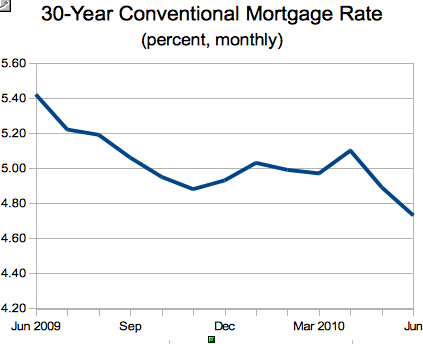
Source: Federal reserve Bank of St. Louis, MBA
The fiscal turmoil in the eurozone since the beginning of the year, an ongoing downward drift of domestic inflation, and a modest loss of momentum in the economic reports recently have all conspired to fuel a powerful rally in the bond market, driving mortgage yields lower as well. This dynamic has trampled any demand/supply-related considerations stemming from the Fed's withdrawal from the mortgage market in the second quarter.
As we have argued before, supply is a temptingly convenient factor to use in any rationale attempting to forecast the direction of long-term yields. In reality, though, it has a particularly poor track record to justify such attention. The most dramatic perhaps demonstration of the exaggerated importance that markets often attribute to supply is the fact that Treasury yields have been able to absorb a massive onslaught of supply in the last 18 months, without any signs of indigestion and remain near historically record-low levels, despite an economic recovery that has been taking hold for nearly a year now.
The advocates of supply as a key determinant of market yields always offer the caveat of "all other things being equal". The problem is that, outside the universe of academic research and computer models, those "other things" are almost never equal. In fact, changes in supply conditions typically contain the very seeds of a powerful counter-effect that neutralizes its impact. For example, the massive Treasury fiscal deficits were the direct result of a sever financial crisis and deep recession, both of which were potent forces pushing yields lower.
A similar explanation accounts for the impressive resilience of mortgage rates following the end of the Fed's purchase program; that is, the broader conditions in both the domestic economy and global market environment were a far more dominant driving force of such yields than the end of the Fed's purchase program.
Anthony Karydakis
Monday, June 28, 2010
A Cautionary Note On the Data Ahead
With the economic recovery steadily approaching a key juncture, the overall tone of the various economic releases may also change as a result, projecting an overall softer undertone that may help support the latest downward drift of bond market yields.
In the three most recent quarters, since the recovery got under way, economic growth has benefited heavily from the classic inventory cycle, which contributed 0.7, 3.8, and 1.9 percentage points respectively to GDP growth since Q3 2009; in some cases, like in Q4 2009, a faster rate of inventory accumulation accounted for 2/3 of the entire GDP growth. With the inventory dynamic slowly- but predictably- losing its fizzle, and the the boost from last year's fiscal stimulus waning by year end, a perceptible risk exists that, economic growth may be downshifting in the second half of the year, unless another sector of the economy makes up for that.
The implication of this is that pressure is building on employment growth to pick up materially in the coming months to support stronger income growth and consumer spending. The labor market statistics have been quite mixed recently, with private payrolls stalling, following a solid turnaround in the first quarter, and initial claims essentially treading water since the beginning of the year.
The relatively unimpressive picture of labor market conditions does not represent a direct threat to the viability of the recovery per se, as the latter has already entered credibly the phase of a self-sustaining expansionary dynamic. However, it does hold the key to the pace of economic growth over the next 3 to 4 quarters.
Against such a background, the importance of the ever-pivotal employment report on Friday may be greater than usual.
With a potentially sizable number of temporary census workers laid off in June, the focus, once again, should be on private payrolls, which have averaged a fairly respectable 139,000 in the last three months. Even if the nominal payroll print for the month is only marginally positive, or even a small negative, a gain in the 150,000 to 200,000 range for private payrolls would be encouraging and consistent with economic growth plowing ahead at a solid clip. However, a private payroll gain in June comparable to the disappointing 41,000 reported for May may require a reassessment of the working assumption that the recovery can sustain a growth rate in the 3 1/2% to 4% range into early 2011.
Time is running out for the employment picture to show its hand.
Anthony Karydakis
In the three most recent quarters, since the recovery got under way, economic growth has benefited heavily from the classic inventory cycle, which contributed 0.7, 3.8, and 1.9 percentage points respectively to GDP growth since Q3 2009; in some cases, like in Q4 2009, a faster rate of inventory accumulation accounted for 2/3 of the entire GDP growth. With the inventory dynamic slowly- but predictably- losing its fizzle, and the the boost from last year's fiscal stimulus waning by year end, a perceptible risk exists that, economic growth may be downshifting in the second half of the year, unless another sector of the economy makes up for that.
The implication of this is that pressure is building on employment growth to pick up materially in the coming months to support stronger income growth and consumer spending. The labor market statistics have been quite mixed recently, with private payrolls stalling, following a solid turnaround in the first quarter, and initial claims essentially treading water since the beginning of the year.
The relatively unimpressive picture of labor market conditions does not represent a direct threat to the viability of the recovery per se, as the latter has already entered credibly the phase of a self-sustaining expansionary dynamic. However, it does hold the key to the pace of economic growth over the next 3 to 4 quarters.
Against such a background, the importance of the ever-pivotal employment report on Friday may be greater than usual.
With a potentially sizable number of temporary census workers laid off in June, the focus, once again, should be on private payrolls, which have averaged a fairly respectable 139,000 in the last three months. Even if the nominal payroll print for the month is only marginally positive, or even a small negative, a gain in the 150,000 to 200,000 range for private payrolls would be encouraging and consistent with economic growth plowing ahead at a solid clip. However, a private payroll gain in June comparable to the disappointing 41,000 reported for May may require a reassessment of the working assumption that the recovery can sustain a growth rate in the 3 1/2% to 4% range into early 2011.
Time is running out for the employment picture to show its hand.
Anthony Karydakis
Thursday, June 24, 2010
The FOMC Statement: The Day After
The FOMC's unambiguously bond market-friendly statement yesterday provided a strong boost to Treasuries, triggering a rally that has brought the 10-year yield within striking distance of the 3% mark.
In surveying the landscape today, a few comments are in order:
1) The subtle, but unmistakable, caution reflected in the Committee's assessment of the growth prospects, pushes the possible timing of the first tightening move well into 2011 (with a more specific handle on such timing being hard to assess at this distance). This is strongly reinforced by the acknowledgement in the Committee's statement that, in addition to financial market conditions that are not "supportive" of growth", inflation is also trending lower. It is critical to stress here that an outright Fed tightening move does not necessarily have to coincide with the beginning of any asset sales from the Fed's portfolio, as the latter might come first- although it has now also been pushed further out. (We will have a special article on the various pieces of the Fed's exit strategy in the coming days).
2) While fed funds futures moved quickly to remove the bulk of any risk for a Fed move this year (with only a "natural" residual of risk left in the pricing of the December contract due to ever-present, background concern about year-end distortions in the funds market), Eurodollar futures continue to reflect a moderate, steady uptrend in the 3-month LIBOR rate- the direct effect of ongoing concerns about bank liquidity. Such concerns are also fueled by the prospect of the release of the bank stress-test results in Europe at some point next month.
3) With the Treasury yield curve on course to maintain its core steepness for quite some time now, plain, old-fashioned carry trades remain very much in vogue. Viewed from a slightly different angle, this implies that any curve flattening trades, which may still have some appeal in the midst of a potential stretch of strong economic reports, should be managed with caution and viewed as purely tactical and with limited objectives.
Anthony Karydakis
In surveying the landscape today, a few comments are in order:
1) The subtle, but unmistakable, caution reflected in the Committee's assessment of the growth prospects, pushes the possible timing of the first tightening move well into 2011 (with a more specific handle on such timing being hard to assess at this distance). This is strongly reinforced by the acknowledgement in the Committee's statement that, in addition to financial market conditions that are not "supportive" of growth", inflation is also trending lower. It is critical to stress here that an outright Fed tightening move does not necessarily have to coincide with the beginning of any asset sales from the Fed's portfolio, as the latter might come first- although it has now also been pushed further out. (We will have a special article on the various pieces of the Fed's exit strategy in the coming days).
2) While fed funds futures moved quickly to remove the bulk of any risk for a Fed move this year (with only a "natural" residual of risk left in the pricing of the December contract due to ever-present, background concern about year-end distortions in the funds market), Eurodollar futures continue to reflect a moderate, steady uptrend in the 3-month LIBOR rate- the direct effect of ongoing concerns about bank liquidity. Such concerns are also fueled by the prospect of the release of the bank stress-test results in Europe at some point next month.
3) With the Treasury yield curve on course to maintain its core steepness for quite some time now, plain, old-fashioned carry trades remain very much in vogue. Viewed from a slightly different angle, this implies that any curve flattening trades, which may still have some appeal in the midst of a potential stretch of strong economic reports, should be managed with caution and viewed as purely tactical and with limited objectives.
Anthony Karydakis
Wednesday, June 23, 2010
Europe's Fiscal Crisis May Help the Euro's Survival
The recent fiscal turmoil and associated existential doubts about the fate of the eurozone's common currency may have actually been a particularly constructive development for the latter's future, as they have brought to the forefront the long-simmering underlying tensions with an unmistakable sense of urgency to address them head-on.
This dynamic has led to a barrage of meaningful proposals about a new, tighter framework that would allow for a better harmonization of underlying fiscal policies among the bloc's various countries and also a mechanism for closer supervision to ensure compliance with stated targets. The ECB President put forward such a plan earlier in the week (http://wallstreetpit.com/32435-ecbs-trichet-eu-governments-in-breach-of-fiscal-rules-could-lose-voting-rights), which has the tacit support of the powers-that-be within the EU. The exposition of the fault lines within the eurozone's member countries has left virtually no room for ignoring that ticking bomb that had always been identified, since the inception of the euro, as a potential threat to its long-term survival.
In the near-term, the wave of fiscal austerity measures sweeping the european countries- including, most notably, the U.K (a non-eurozone mmeber)- is meant to help defuse the immediate global financial market anxiety vis-a-vis the european countries' sovereign debt. At the same time, the longer-term plans laid out by the EU to prevent such a turmoil in the future can go a long way toward redressing the massive productivity gaps and sense of fiscal discipline in the future among the various member countries, which would strengthen the common currency's prospects.
The institutional response by the EU to the recent crisis may not be succeed in putting the recent financial market uneasiness to rest any time soon, as markets are famously demanding of hard evidence establishing the effectiveness of such measures in correcting the underlying problem. In fact, a risk does exist that, over the next couple of years, some marginal reconfiguration of the euro countries may take place, as Greece's longer-term ability to participate hangs in the balance. However, in a little noticed development last week, Estonia (with a total public debt of only a minuscule 7.2% of GDP) also announced it will be joining the euro club as of January 2011, increasing the number of participating countries to 17 (http://www.nytimes.com/2010/06/18/business/global/18euro.html).
The key point is that while a possible reshuffling of countries using the euro in the future remains a distinct risk, an outright break-up of the common currency is, by the same token, a particularly low probability outcome over the medium-term. In fact, the recent- and, mostly, ongoing- unsettling fiscal situation in the eurozone may have increased the prospects of the euro's survival down the road.
Anthony Karydakis
This dynamic has led to a barrage of meaningful proposals about a new, tighter framework that would allow for a better harmonization of underlying fiscal policies among the bloc's various countries and also a mechanism for closer supervision to ensure compliance with stated targets. The ECB President put forward such a plan earlier in the week (http://wallstreetpit.com/32435-ecbs-trichet-eu-governments-in-breach-of-fiscal-rules-could-lose-voting-rights), which has the tacit support of the powers-that-be within the EU. The exposition of the fault lines within the eurozone's member countries has left virtually no room for ignoring that ticking bomb that had always been identified, since the inception of the euro, as a potential threat to its long-term survival.
In the near-term, the wave of fiscal austerity measures sweeping the european countries- including, most notably, the U.K (a non-eurozone mmeber)- is meant to help defuse the immediate global financial market anxiety vis-a-vis the european countries' sovereign debt. At the same time, the longer-term plans laid out by the EU to prevent such a turmoil in the future can go a long way toward redressing the massive productivity gaps and sense of fiscal discipline in the future among the various member countries, which would strengthen the common currency's prospects.
The institutional response by the EU to the recent crisis may not be succeed in putting the recent financial market uneasiness to rest any time soon, as markets are famously demanding of hard evidence establishing the effectiveness of such measures in correcting the underlying problem. In fact, a risk does exist that, over the next couple of years, some marginal reconfiguration of the euro countries may take place, as Greece's longer-term ability to participate hangs in the balance. However, in a little noticed development last week, Estonia (with a total public debt of only a minuscule 7.2% of GDP) also announced it will be joining the euro club as of January 2011, increasing the number of participating countries to 17 (http://www.nytimes.com/2010/06/18/business/global/18euro.html).
The key point is that while a possible reshuffling of countries using the euro in the future remains a distinct risk, an outright break-up of the common currency is, by the same token, a particularly low probability outcome over the medium-term. In fact, the recent- and, mostly, ongoing- unsettling fiscal situation in the eurozone may have increased the prospects of the euro's survival down the road.
Anthony Karydakis
Monday, June 21, 2010
The Yuan Announcement and Market Reactions
This morning's dominant piece of news for financial markets is China's announcement over the weekend that it would adopt a "more flexible" exchange rate policy with the yuan. As a result, commodities and equities are rallying, on the rationale, that the likely appreciation of the yuan will lead to stronger economic growth in the U.S. (and, therefore, stronger corporate profits and demand for commodities), while the bond market is, predictably, taking a hit.
As an initial, broad, assessment of the significance of the move on the yuan, the front page article in today's WSJ ("China Eases Currency peg) is a reasonably adequate one. However, in evaluating the financial markets' reaction to the news, and the sustainability of this morning's price dynamic, some perspective is desperately required.
Despite this morning's fairly substantial rise, by nearly 0.5%, of the yuan against the dollar, the pace of further appreciation is likely to proceed very slowly, with the likely total amount of such appreciation by year end probably limited to the 4% to 5% range. Such a tightly controlled pace of the yuan's rise over the next six months or so is likely to be mostly due to two factors: a) The strong influence of the export lobby in China that will strenuously resist a more substantial pace of appreciation, particularly in an environment where their main export markets are growing at a very unimpressive pace, and b) The fact that the yuan is going to be managed against a basket of currencies, with the euro being one of its key components; if the euro's recent weakness persists, then the rise of the yuan against the dollar will have to be very limited to offset its potential further rise against the euro within the basket.
Against that backdrop, it is hard to imagine the prospect of a more flexible yuan policy ahead, which will probably lead to a further moderate appreciation next year, becoming a game-changer for the outlook of the U.S. economy over the next 12 to 18 months. Actually, the manufacturing sector, which is presumably the sector of the U.S. economy likely to benefit the most by a stronger yuan, has been doing particularly well in the last 9 months, having already become a key driving force of the economic recovery.
But the problem is not the manufacturing sector. The key challenges for the U.S. recovery over the medium-term include a still cautious pace of job creation, tight bank lending standards, any ripple effect from the fiscal turmoil in the eurozone, and the lingering drag from the housing market meltdown. Potentially stronger exports to China over that time frame are not likely to materially alter the outlook for economic growth in the U.S.
As a result, it is questionable whether the stock market's enthusiasm generated by the yuan announcement over the weekend will have long enough legs- that is, beyond a matter of a few days- to sustain a powerful rally in equity prices. It will not be before long when both equities and Treasuries refocus on the underlying realities permeating the current economic environment.
The prospect of only a cautiously optimistic FOMC statement on Wednesday -a reminder that the economic environment is still confronting a number of headwinds-, uneven economic data (with the emphasis on this week's struggling initial claims series and the magnitude of the likely decline in May's durable goods orders) may help put a brake on the stock market rally and the slide in Treasuries by the end of the week.
Anthony Karydakis
As an initial, broad, assessment of the significance of the move on the yuan, the front page article in today's WSJ ("China Eases Currency peg) is a reasonably adequate one. However, in evaluating the financial markets' reaction to the news, and the sustainability of this morning's price dynamic, some perspective is desperately required.
Despite this morning's fairly substantial rise, by nearly 0.5%, of the yuan against the dollar, the pace of further appreciation is likely to proceed very slowly, with the likely total amount of such appreciation by year end probably limited to the 4% to 5% range. Such a tightly controlled pace of the yuan's rise over the next six months or so is likely to be mostly due to two factors: a) The strong influence of the export lobby in China that will strenuously resist a more substantial pace of appreciation, particularly in an environment where their main export markets are growing at a very unimpressive pace, and b) The fact that the yuan is going to be managed against a basket of currencies, with the euro being one of its key components; if the euro's recent weakness persists, then the rise of the yuan against the dollar will have to be very limited to offset its potential further rise against the euro within the basket.
Against that backdrop, it is hard to imagine the prospect of a more flexible yuan policy ahead, which will probably lead to a further moderate appreciation next year, becoming a game-changer for the outlook of the U.S. economy over the next 12 to 18 months. Actually, the manufacturing sector, which is presumably the sector of the U.S. economy likely to benefit the most by a stronger yuan, has been doing particularly well in the last 9 months, having already become a key driving force of the economic recovery.
But the problem is not the manufacturing sector. The key challenges for the U.S. recovery over the medium-term include a still cautious pace of job creation, tight bank lending standards, any ripple effect from the fiscal turmoil in the eurozone, and the lingering drag from the housing market meltdown. Potentially stronger exports to China over that time frame are not likely to materially alter the outlook for economic growth in the U.S.
As a result, it is questionable whether the stock market's enthusiasm generated by the yuan announcement over the weekend will have long enough legs- that is, beyond a matter of a few days- to sustain a powerful rally in equity prices. It will not be before long when both equities and Treasuries refocus on the underlying realities permeating the current economic environment.
The prospect of only a cautiously optimistic FOMC statement on Wednesday -a reminder that the economic environment is still confronting a number of headwinds-, uneven economic data (with the emphasis on this week's struggling initial claims series and the magnitude of the likely decline in May's durable goods orders) may help put a brake on the stock market rally and the slide in Treasuries by the end of the week.
Anthony Karydakis
Thursday, June 17, 2010
Picture-Perfect May CPI But Initial Claims Raise Some Eyebrows
The May CPI report is near-perfect in that it confirms the picture of uneventful price trends, putting to rest any lingering concern about either inflationary, or deflationary, impulses in the current environment.
The 0.2% decline in the overall index last month was the result of a 2.9% fall in the energy component- the latter largely due to a 5.2% drop in gasoline prices. The core CPI's increase of 0.1% for the month, follows a flat reading in April, and represents only the second gain in the series since the beginning of the year. In fact, in the last 6 months to May, the core CPI has been up 0.8%, while in the last three months, it has risen by only 0.4%. Year-on-year, core inflation is up 0.9%.

Source: Bureau of Labor Statistics
In the last three months, the key housing component (which represents 40% of the overall CPI) has been flat (with a 9% drop in fuel oil prices helping offset a 15.8% spike in the "lodging away from home" category), while apparel prices have declined by 4.2% and, even medical costs have risen by a relatively moderate -by the standards of that component- 2.9%.
The impressively benign price picture is hardly surprising, given the abundant amount of slack in the economy and its slow absorption rate in in the midst of a moderate economic recovery, with these factors likely to continue taming price trends over the next 12 months or so.
Inasmuch as the favorable price dynamic should appropriately be viewed as providing the Fed with ample space to delay the onset of the tightening process, it is important to recognize that the monthly inflation data are not likely to be the primary reason that will determine the timing of the Fed's exit strategy. Instead, that is more likely to be shaped by a combination of the Fed's assessment of three factors: a) the economic recovery's prospects -particularly, in the wake of the fiscal turmoil in Europe- b) the ability of the global financial system to withstand the stress that a turnaround in the U.S. interest rate cycle would entail, and c) the degree of restlessness on the ground (i.e financial markets) about the need to see that the Fed remains vigilant vis-a-vis the longer-term inflation risks posed by the liquidity currently in the system.
The 12,000 rise in initial unemployment claims in the week of June 12 to 472,000 would not disconcerting per se, given the inherent volatility of the series, but it does validate a disappointing pattern of an essentially stalled downtrend in claims since the beginning of the year. The 4-week moving average of the series is now at 464,000, not much different compared to five months ag0.
The puzzle with the behavior of claims in recent months is that it stands in sharp contrast with the significant overall turnaround we have seen in the monthly payroll data and most other labor market measures. Although, we should not expect claims and payrolls to go hand-in-hand over the short-term, one would have thought that a nearly six-month period is long enough to have allowed the two series to send a more consistent message.
One explanation for the disconnect is that the payroll data may ultimately be revised downward for the first part of the year during the annual benchmark revisions of the series next spring. Another possible, but not fully satisfactory, explanation is that the last recession has caused profound dislocations among the various sectors in the economy, where some industries continue to shed off jobs at a strong pace (therefore accounting for the still elevated level of lay-offs), while other industries are turning around in a more robust fashion, accounting for the bulk of the hiring reflected in the improved payroll data.
Today's initial claims data were for the survey week of the June employment report and there is usually an attempt to use claims as a hint for what the monthly employment report may look like. The correlation between initial claims during the employment survey week and payrolls for that month is non-existent, but, at times, some loose relationship may exist between new filings and the unemployment rate. Still, there is no meaningful hint that can be derived from today's data, as the 472,000 claims number today was nearly identical to the 474,000 claims number for the survey week in May.
The rise by 88,000 to 4.571 million in the continuing claims for the week of June 5th is also consistent with the broader theme of lack of progress on the front of both initial filings and claims recipients.
Anthony Karydakis
The 0.2% decline in the overall index last month was the result of a 2.9% fall in the energy component- the latter largely due to a 5.2% drop in gasoline prices. The core CPI's increase of 0.1% for the month, follows a flat reading in April, and represents only the second gain in the series since the beginning of the year. In fact, in the last 6 months to May, the core CPI has been up 0.8%, while in the last three months, it has risen by only 0.4%. Year-on-year, core inflation is up 0.9%.

Source: Bureau of Labor Statistics
In the last three months, the key housing component (which represents 40% of the overall CPI) has been flat (with a 9% drop in fuel oil prices helping offset a 15.8% spike in the "lodging away from home" category), while apparel prices have declined by 4.2% and, even medical costs have risen by a relatively moderate -by the standards of that component- 2.9%.
The impressively benign price picture is hardly surprising, given the abundant amount of slack in the economy and its slow absorption rate in in the midst of a moderate economic recovery, with these factors likely to continue taming price trends over the next 12 months or so.
Inasmuch as the favorable price dynamic should appropriately be viewed as providing the Fed with ample space to delay the onset of the tightening process, it is important to recognize that the monthly inflation data are not likely to be the primary reason that will determine the timing of the Fed's exit strategy. Instead, that is more likely to be shaped by a combination of the Fed's assessment of three factors: a) the economic recovery's prospects -particularly, in the wake of the fiscal turmoil in Europe- b) the ability of the global financial system to withstand the stress that a turnaround in the U.S. interest rate cycle would entail, and c) the degree of restlessness on the ground (i.e financial markets) about the need to see that the Fed remains vigilant vis-a-vis the longer-term inflation risks posed by the liquidity currently in the system.
The 12,000 rise in initial unemployment claims in the week of June 12 to 472,000 would not disconcerting per se, given the inherent volatility of the series, but it does validate a disappointing pattern of an essentially stalled downtrend in claims since the beginning of the year. The 4-week moving average of the series is now at 464,000, not much different compared to five months ag0.
The puzzle with the behavior of claims in recent months is that it stands in sharp contrast with the significant overall turnaround we have seen in the monthly payroll data and most other labor market measures. Although, we should not expect claims and payrolls to go hand-in-hand over the short-term, one would have thought that a nearly six-month period is long enough to have allowed the two series to send a more consistent message.
One explanation for the disconnect is that the payroll data may ultimately be revised downward for the first part of the year during the annual benchmark revisions of the series next spring. Another possible, but not fully satisfactory, explanation is that the last recession has caused profound dislocations among the various sectors in the economy, where some industries continue to shed off jobs at a strong pace (therefore accounting for the still elevated level of lay-offs), while other industries are turning around in a more robust fashion, accounting for the bulk of the hiring reflected in the improved payroll data.
Today's initial claims data were for the survey week of the June employment report and there is usually an attempt to use claims as a hint for what the monthly employment report may look like. The correlation between initial claims during the employment survey week and payrolls for that month is non-existent, but, at times, some loose relationship may exist between new filings and the unemployment rate. Still, there is no meaningful hint that can be derived from today's data, as the 472,000 claims number today was nearly identical to the 474,000 claims number for the survey week in May.
The rise by 88,000 to 4.571 million in the continuing claims for the week of June 5th is also consistent with the broader theme of lack of progress on the front of both initial filings and claims recipients.
Anthony Karydakis
Monday, June 14, 2010
In Defense of the ECB
The ECB has received a considerable amount of criticism in recent weeks, as a result of its decision last month to start buying sovereign debt of some of the euro bloc's most vulnerable countries. The essence of the, at times, surprisingly sharp tone of such criticism is that the ECB has compromised its strongly prized sense of independence and is now succumbing to political pressures to pull out all the stops to contain the fiscal turmoil that has spread ominously across much of the eurozone. Furthermore, the critics argue, by doing so, the ECB is undercutting its much cherished anti-inflation credentials
The ECB's purchases of sovereign, euro-denominated, bonds have been fairly aggressive so far, with a total of over EUR40 billion of such purchases having settled in the first three weeks of the program. ECB watchers expect the program to reach EUR 60 to 70 billion in the foreseeable future. Although no official breakdown is available regarding the issuing countries of the bonds purchased, it is widely believed that the bulk of those purchases involve Greek debt.
The criticism of the ECB on this issue has been unfair and, by most reasonable standards, widely off-the-mark.
Despite the ECB's much publicized single mandate of keeping inflation in the eurozone "below, but close to, 2%", it is always the unspoken, but paramount, responsibility of any central bank to preserve the integrity of the financial system in the country/zone of its operation in periods of pronounced stress. That is exactly what major central banks have always done under such circumstances in recent history, with the most dramatic such episode being the 2008-09 global financial crisis.
In response to the crisis, both the Fed and the ECB took a number of unprecedented measures, some of which were going directly against the traditional concept of a central bank as the ultimate inflation fighter. It was precisely in that context that the Fed engaged in a program of purchasing $300 billion of Treasury securities, crossing a line that was nearly unthinkable in the past- namely of debt monetization; and this, before including the massive program of purchasing mortgage-backed and agency securities, totaling $1.4 trillion. During that period, the ECB conspicuously refrained from purchasing any sovereign debt of its member countries and limited itself to purchasing a total of EUR 60 billion of "eligible covered bonds" in the open market.
That the ECB is coming now under fire for moving aggressively to help extinguish the fire ignited by the fiscal turmoil that has threatened the integrity of the euro, is a serious misreading of its true mission. Meeting the inflation target "over the medium term" is certainly critical, but, first, Mr. Trichet needs to keep the eurozone in one piece to be able to conduct monetary policy with the objective of meeting his single mandate on inflation. There would be no role for the ECB to play if the eurozone collapsed. In fact, it would be negligence, bordering on serious monetary policymaking malpractice, for the ECB to refrain from taking significant special measures in the midst of the bloc's intense fiscal crisis.
As far as the potential inflation repercussions of the ECB's recent program of sovereign debt purchases, the risk appears quite limited. The HICP (Harmonized Index of Consumer prices) for the eurozone is running at 1.5% in the 12-month period to April and is expected to tick higher to 1.6% after the release of the May data tomorrow (6/16/10). Although it does represent an appreciable upturn compared to its low point six months ago and it is still comfortably below the 2% target. Besides, it would be unreasonable to believe that the projected modest pace of eurozone GDP growth in 2010-11 of about 1.5% represents a risk of generating any inflationary impulses.
Mr. Trichet's anti-inflation credentials have been impeccable in the last six and a half years at the helm of the ECB. Inflation is running close to its lowest since the inception of the euro and is lower than the rate prevailing in most legacy countries prior to the creation of the common currency. If anything, he has often been criticized in the past for being overly committed to the ECB's official inflation target, often at the expense of growth in the eurozone and with a steady bias toward keeping monetary policy a notch or two tighter than circumstances might have warranted at various points. (After all, the intense criticism he received for being in a tightening mode in early July 2008 -having raised the ECB's overnight rate by 25 basis points to 4.25% in just two months prior to the Lehman affair- is still fresh).
The ECB and Jean-Claude Trichet have built enough capital with their strong anti-inflation credentials over the years that they should not be viewed with suspicion as to whether they are compromising their commitment to price stability with their bond purchase program in response to an exceptional set of circumstances that they have been confronted with. They deserve more credit than that. Doing otherwise simply highlights the sad reality that markets have, indeed, very short memory.
Anthony Karydakis
The ECB's purchases of sovereign, euro-denominated, bonds have been fairly aggressive so far, with a total of over EUR40 billion of such purchases having settled in the first three weeks of the program. ECB watchers expect the program to reach EUR 60 to 70 billion in the foreseeable future. Although no official breakdown is available regarding the issuing countries of the bonds purchased, it is widely believed that the bulk of those purchases involve Greek debt.
The criticism of the ECB on this issue has been unfair and, by most reasonable standards, widely off-the-mark.
Despite the ECB's much publicized single mandate of keeping inflation in the eurozone "below, but close to, 2%", it is always the unspoken, but paramount, responsibility of any central bank to preserve the integrity of the financial system in the country/zone of its operation in periods of pronounced stress. That is exactly what major central banks have always done under such circumstances in recent history, with the most dramatic such episode being the 2008-09 global financial crisis.
In response to the crisis, both the Fed and the ECB took a number of unprecedented measures, some of which were going directly against the traditional concept of a central bank as the ultimate inflation fighter. It was precisely in that context that the Fed engaged in a program of purchasing $300 billion of Treasury securities, crossing a line that was nearly unthinkable in the past- namely of debt monetization; and this, before including the massive program of purchasing mortgage-backed and agency securities, totaling $1.4 trillion. During that period, the ECB conspicuously refrained from purchasing any sovereign debt of its member countries and limited itself to purchasing a total of EUR 60 billion of "eligible covered bonds" in the open market.
That the ECB is coming now under fire for moving aggressively to help extinguish the fire ignited by the fiscal turmoil that has threatened the integrity of the euro, is a serious misreading of its true mission. Meeting the inflation target "over the medium term" is certainly critical, but, first, Mr. Trichet needs to keep the eurozone in one piece to be able to conduct monetary policy with the objective of meeting his single mandate on inflation. There would be no role for the ECB to play if the eurozone collapsed. In fact, it would be negligence, bordering on serious monetary policymaking malpractice, for the ECB to refrain from taking significant special measures in the midst of the bloc's intense fiscal crisis.
As far as the potential inflation repercussions of the ECB's recent program of sovereign debt purchases, the risk appears quite limited. The HICP (Harmonized Index of Consumer prices) for the eurozone is running at 1.5% in the 12-month period to April and is expected to tick higher to 1.6% after the release of the May data tomorrow (6/16/10). Although it does represent an appreciable upturn compared to its low point six months ago and it is still comfortably below the 2% target. Besides, it would be unreasonable to believe that the projected modest pace of eurozone GDP growth in 2010-11 of about 1.5% represents a risk of generating any inflationary impulses.
Mr. Trichet's anti-inflation credentials have been impeccable in the last six and a half years at the helm of the ECB. Inflation is running close to its lowest since the inception of the euro and is lower than the rate prevailing in most legacy countries prior to the creation of the common currency. If anything, he has often been criticized in the past for being overly committed to the ECB's official inflation target, often at the expense of growth in the eurozone and with a steady bias toward keeping monetary policy a notch or two tighter than circumstances might have warranted at various points. (After all, the intense criticism he received for being in a tightening mode in early July 2008 -having raised the ECB's overnight rate by 25 basis points to 4.25% in just two months prior to the Lehman affair- is still fresh).
The ECB and Jean-Claude Trichet have built enough capital with their strong anti-inflation credentials over the years that they should not be viewed with suspicion as to whether they are compromising their commitment to price stability with their bond purchase program in response to an exceptional set of circumstances that they have been confronted with. They deserve more credit than that. Doing otherwise simply highlights the sad reality that markets have, indeed, very short memory.
Anthony Karydakis
Thursday, June 10, 2010
The Real Problem With An Early Fed Tightening Move
The Kansas City Fed President, Thomas Hoenig, has been an increasingly vocal proponent of the view that that the Fed should no longer offer financial markets the promise of zero short-term rates for an "extended period" of time- having dissented in each FOMC meeting since the beginning of the year over the use of such language in the official statement. In recent days, and on two separate occasions, he has upped the ante by arguing that the Fed should raise the fed funds rate to 1% by the end of summer. (http://www.reuters.com/article/idUSN0810408120100609)
Mr. Hoenig's rationale is a fairly straightforward one: short-term rates are at unustainably low levels, setting the stage for inflationary complications over the long run, and the economic recovery has already gained sufficient traction to withstand a series of modest steps that would signal the beginning of the normalization process for rates. Furthermore, according to that view, monetary policy is meant to be anticipatory and leaving rates at zero for too long would risk planting the seeds for the next bubble that could destabilize the financial system again; therefore, it needs to act soon before any such clouds appear on the radar screen.
A limited number of other Fed officials also appear to be showing signs of uneasiness recently about the possibility that the Fed may be creating some risks by delaying the beginning of the exit strategy; Philadelphia Fed President Plosser and St. Louis Fed President Bullard have made some "soft" comments along those lines in the last few weeks.
On the face of it, it is hard to disagree with Mr. Hoenig's argument on this issue. The U.S. economic recovery is moving forward in the context of a broader, albeit uneven, turnaround in the global economy and the financial system. Although the latter is still confronted with seemingly never-ending challenges (the latest one being the sovereign debt market turmoil), it has admittedly come a long way since the heady days of 18 months or so ago. Against such a backdrop, how damaging a relatively modest increase of 75 to 100 basis points in the fed funds rate- or beginning the unwinding of the Fed's massive portfolio- can be to the economy or the financial system?
This view, though, does suffer from a serious flaw in that it vastly underestimates the potentially disproportionate negative reaction that financial markets will show to concrete actions signaling that the interest rate cycle is turning. The Fed's raising of the fed funds target, as well as the interest it pays on bank reserves, by as much as 100 basis points in a series of quick moves over the next couple of months (the latest time frame proposed by the Kansas City Fed President) is likely to lead to a major selloff in the bond market, as participants, in typical fashion, will front run the prospect of further tightening by the Fed. After all, the funds rate would still be at an extremely low 1% and, by most people's standards, the concept of normalization of short-term rates would envision a road toward a funds target in the 3% to 4% range.
The bulk of such a selloff in response to the Fed's first shot across the bow would be heavily skewed toward the front end of the market, causing a severe flattening of the yield curve, which, in turn, would undercut one of the key factors that have contributed to the healing and return to relative profitability of the banking system in the last several quarters. In view of the recent doubling of the 3-month Libor rate to over 50 basis points- a direct reflection of the anxiety percolating in the European banking system due to the sovereign debt situation- an abrupt further increase in short-term rates that would be set off by any Fed tightening can prove dangerously destabilizing for the global financial system in the current setting.
Inflation in the U.S. and eurozone remains at extremely low levels and, given the unimpressive forward momentum of the economic recovery in both regions, it is unlikely to show any upturn over the next 12 months or so. With regulatory financial reform in the offing, both in the U.S. and Europe, and the threat of a default by some countries (the debt of which is largely held by European banks) lurking in the background, the global banking system is finding itself again at a key juncture.
None of this suggests that the Fed should remain sidelined out of fear of potentially disturbing the fledgling economic recovery and delicate balance of the banking system. Short-term rates are indeed unsustainably low and the gradual unwinding of the Fed's balance sheet may indeed start taking place later this year, before any other overt tightening policy action is announced.
But it is imperative to recognize that the view Mr. Hoenig has been openly advocating has a major hidden risk, as it is not about just a series of modest steps that would still leave the funds target at a historically very low level- therefore unlikely to be very consequential to the broader environment. A series of modest such rate hikes by the Fed will translate into a potentially massive back up in yields that would far exceed the actual Fed action. And for that to be absorbed relatively smoothly (that is, with only a reasonable amount of noise), without throwing everything up in the air and creating renewed sources of anxiety and turmoil, the Fed needs to be highly confident that the time is ripe for such action.
The inevitable change in the FOMC's language from the current "extended period" wording will be the first test of the markets' ability to handle stress over the next few months, on the account of a perceived risk of real tightening down the road. But, arguing that the overall economic and financial environment is ready at this point to accept the blow of actual Fed tightening over the next couple of months is a proposition somewhat disconnected from the realities on the ground as to how markets function.
Anthony Karydakis
Mr. Hoenig's rationale is a fairly straightforward one: short-term rates are at unustainably low levels, setting the stage for inflationary complications over the long run, and the economic recovery has already gained sufficient traction to withstand a series of modest steps that would signal the beginning of the normalization process for rates. Furthermore, according to that view, monetary policy is meant to be anticipatory and leaving rates at zero for too long would risk planting the seeds for the next bubble that could destabilize the financial system again; therefore, it needs to act soon before any such clouds appear on the radar screen.
A limited number of other Fed officials also appear to be showing signs of uneasiness recently about the possibility that the Fed may be creating some risks by delaying the beginning of the exit strategy; Philadelphia Fed President Plosser and St. Louis Fed President Bullard have made some "soft" comments along those lines in the last few weeks.
On the face of it, it is hard to disagree with Mr. Hoenig's argument on this issue. The U.S. economic recovery is moving forward in the context of a broader, albeit uneven, turnaround in the global economy and the financial system. Although the latter is still confronted with seemingly never-ending challenges (the latest one being the sovereign debt market turmoil), it has admittedly come a long way since the heady days of 18 months or so ago. Against such a backdrop, how damaging a relatively modest increase of 75 to 100 basis points in the fed funds rate- or beginning the unwinding of the Fed's massive portfolio- can be to the economy or the financial system?
This view, though, does suffer from a serious flaw in that it vastly underestimates the potentially disproportionate negative reaction that financial markets will show to concrete actions signaling that the interest rate cycle is turning. The Fed's raising of the fed funds target, as well as the interest it pays on bank reserves, by as much as 100 basis points in a series of quick moves over the next couple of months (the latest time frame proposed by the Kansas City Fed President) is likely to lead to a major selloff in the bond market, as participants, in typical fashion, will front run the prospect of further tightening by the Fed. After all, the funds rate would still be at an extremely low 1% and, by most people's standards, the concept of normalization of short-term rates would envision a road toward a funds target in the 3% to 4% range.
The bulk of such a selloff in response to the Fed's first shot across the bow would be heavily skewed toward the front end of the market, causing a severe flattening of the yield curve, which, in turn, would undercut one of the key factors that have contributed to the healing and return to relative profitability of the banking system in the last several quarters. In view of the recent doubling of the 3-month Libor rate to over 50 basis points- a direct reflection of the anxiety percolating in the European banking system due to the sovereign debt situation- an abrupt further increase in short-term rates that would be set off by any Fed tightening can prove dangerously destabilizing for the global financial system in the current setting.
Inflation in the U.S. and eurozone remains at extremely low levels and, given the unimpressive forward momentum of the economic recovery in both regions, it is unlikely to show any upturn over the next 12 months or so. With regulatory financial reform in the offing, both in the U.S. and Europe, and the threat of a default by some countries (the debt of which is largely held by European banks) lurking in the background, the global banking system is finding itself again at a key juncture.
None of this suggests that the Fed should remain sidelined out of fear of potentially disturbing the fledgling economic recovery and delicate balance of the banking system. Short-term rates are indeed unsustainably low and the gradual unwinding of the Fed's balance sheet may indeed start taking place later this year, before any other overt tightening policy action is announced.
But it is imperative to recognize that the view Mr. Hoenig has been openly advocating has a major hidden risk, as it is not about just a series of modest steps that would still leave the funds target at a historically very low level- therefore unlikely to be very consequential to the broader environment. A series of modest such rate hikes by the Fed will translate into a potentially massive back up in yields that would far exceed the actual Fed action. And for that to be absorbed relatively smoothly (that is, with only a reasonable amount of noise), without throwing everything up in the air and creating renewed sources of anxiety and turmoil, the Fed needs to be highly confident that the time is ripe for such action.
The inevitable change in the FOMC's language from the current "extended period" wording will be the first test of the markets' ability to handle stress over the next few months, on the account of a perceived risk of real tightening down the road. But, arguing that the overall economic and financial environment is ready at this point to accept the blow of actual Fed tightening over the next couple of months is a proposition somewhat disconnected from the realities on the ground as to how markets function.
Anthony Karydakis
Tuesday, June 8, 2010
Is Global Growth Slowing After All?
The presumption that the Eurozone fiscal crisis will be a pivotal factor that will have an adverse effect on global economic growth ahead has been widely adopted by financial markets in recent weeks. While such a potential risk cannot be dismissed, we remain skeptical as to how significant its negative effect on the U.S. (or, global, for that matter) economy will ultimately be.
The OECD, for one, is not so sure. Two weeks ago, it released an upward revised estimate for economic growth in its member countries for 2010 and beyond compared to its previous forecast issued in November 2009. In its latest forecast, it now expects growth to rise by 2.7% this year versus 1.9% in its previous, "pre- Eurozone fiscal crisis" estimate, while it has also revised higher its growth estimate for 2011 to 2.8% from 2.5% previously.
(http://www.oecd.org/document/9/0,3343,en_2649_201185_45303817_1_1_1_1,00.html)
The OECD's upgraded forecast, while acknowledging the growing risks stemming from the instability in sovereign debt markets, is based on the reality of rising global trade flows. This trend is, to a considerable degree fueled by the sharp fall of the euro since late last year and the ongoing strength in growth in China and other key emerging market economies.
Even in the eurozone, which has been squarely in the eye of the fiscal storm recently, it is still not clear whether the net effect of the fiscal austerity measures sweeping its member countries will have a bigger contractionary effect on growth than the benefit to growth derived from the boost to the bloc's exports to other non-euro countries- courtesy of the weaker euro. The latter effect, is in fact, quite powerful, as the euro has not declined by over 20% since late last year against the U.S. dollar alone but also against the yuan, allowing eurozone exports to gain competitive ground globally at the expense of China.
The news coming out of Germany (the world's second biggest exporter) in the last two days highlights that ambiguity best. Factory orders surged in April by 2.8%, after an upward revised 5.1% increase in March, driven by a 5.5% spike in export orders from countries outside the euro area. Also, just this morning, Germany's industrial production numbers showed a solid gain of 0.9% in April, suggesting that the economic recovery in the biggest eurozone economy (and a global exports powerhouse) is moving forward at a good clip.
The single most important channel via which any protracted sovereign debt market instability can influence the U.S. economic recovery is the sharp pullback in equities and its possible adverse effect on consumer spending in the months ahead. Again, the uptrend in personal spending is unlikely to be derailed by a 10% or so erosion in the equity market- particularly if this proves to be a relatively short-lived affair. Moreover, a partial offset to the adverse impact of equities on household spending is provided by the recent sharp increase in mortgage refinancing activity- again, the direct result of the eurozone' fiscal crisis having led to lower market and mortgage rates lately.
Risks to the prospects for the U.S economic recovery do exist and the extend to which the sovereign debt situation deteriorates requires close monitoring in the months ahead. However, in the heat of the moment, there is at times a tendency to underestimate the resilience and complexity of the U.S. economy, and this is a risk we also need to guard against.
Anthony Karydakis
The OECD, for one, is not so sure. Two weeks ago, it released an upward revised estimate for economic growth in its member countries for 2010 and beyond compared to its previous forecast issued in November 2009. In its latest forecast, it now expects growth to rise by 2.7% this year versus 1.9% in its previous, "pre- Eurozone fiscal crisis" estimate, while it has also revised higher its growth estimate for 2011 to 2.8% from 2.5% previously.
(http://www.oecd.org/document/9/0,3343,en_2649_201185_45303817_1_1_1_1,00.html)
The OECD's upgraded forecast, while acknowledging the growing risks stemming from the instability in sovereign debt markets, is based on the reality of rising global trade flows. This trend is, to a considerable degree fueled by the sharp fall of the euro since late last year and the ongoing strength in growth in China and other key emerging market economies.
Even in the eurozone, which has been squarely in the eye of the fiscal storm recently, it is still not clear whether the net effect of the fiscal austerity measures sweeping its member countries will have a bigger contractionary effect on growth than the benefit to growth derived from the boost to the bloc's exports to other non-euro countries- courtesy of the weaker euro. The latter effect, is in fact, quite powerful, as the euro has not declined by over 20% since late last year against the U.S. dollar alone but also against the yuan, allowing eurozone exports to gain competitive ground globally at the expense of China.
The news coming out of Germany (the world's second biggest exporter) in the last two days highlights that ambiguity best. Factory orders surged in April by 2.8%, after an upward revised 5.1% increase in March, driven by a 5.5% spike in export orders from countries outside the euro area. Also, just this morning, Germany's industrial production numbers showed a solid gain of 0.9% in April, suggesting that the economic recovery in the biggest eurozone economy (and a global exports powerhouse) is moving forward at a good clip.
The single most important channel via which any protracted sovereign debt market instability can influence the U.S. economic recovery is the sharp pullback in equities and its possible adverse effect on consumer spending in the months ahead. Again, the uptrend in personal spending is unlikely to be derailed by a 10% or so erosion in the equity market- particularly if this proves to be a relatively short-lived affair. Moreover, a partial offset to the adverse impact of equities on household spending is provided by the recent sharp increase in mortgage refinancing activity- again, the direct result of the eurozone' fiscal crisis having led to lower market and mortgage rates lately.
Risks to the prospects for the U.S economic recovery do exist and the extend to which the sovereign debt situation deteriorates requires close monitoring in the months ahead. However, in the heat of the moment, there is at times a tendency to underestimate the resilience and complexity of the U.S. economy, and this is a risk we also need to guard against.
Anthony Karydakis
Friday, June 4, 2010
May Employment Report: Underwhelming, But Not Ominous
With the emphasis traditionally placed on the headline nonfarm payroll number, today's employment report can only be described as disappointing. The census-bloated payroll increase of 431,000 in May included only a modest 41,000 gain in private payrolls compared to gains of 218,000 and 158,000 in April and March respectively. On such grounds, the Treasury market's initial reaction to the report is fully understandable, and, on some level, perhaps justified.
However, a more dispassionate look at the specifics of the data still points to an ongoing underlying improvement in labor market conditions, albeit at a pace that, overall, still falls short of expectations for this phase of the economic recovery.
Some of the silver lining, that merits attention in the May report includes:
a) A 29,000 increase in manufacturing jobs, which brings the cumulative gain in that category in the last 5 months to 126,000. This is fully consistent with the strong showing of the employment component in the ISM recently, which confirms that the sector is moving ahead at a solid clip.
b) The gain in the workweek for all employees continues to rise, edging up again to 34.2 hours, a classic precursor to more hiring ahead. The series has been showing a steady uptrend since late last year.

Source: Bureau of Labor Statistics
c) In the household survey, the number of persons employed part-time for economic reasons (the so-called involuntary workers) fell by 343,000 last month to 8.8 million. A downtrend in this series should be viewed as a direct reflection of an improving labor market landscape, as employers are increasingly more willing to employ full-time workers in the midst of a turnaround in the overall economic climate.
The drop in the unemployment rate to 9.7% last month from 9.9 in April, is of little material importance, as it essentially returns the series to its Q4 2009 level, and it was mostly the result of a somewhat counter-intuitive fall in the number of unemployed re-entrants to the labor market by 286,000 in May.
Without downplaying the disappointingly slow pace of net new hiring in the private sector, it appears that, apart from the notoriously noisy nonfarm payroll number itself, there is little reason to conclude from today's report that the recovery is in danger of stalling. Such conclusions would represent an overly hasty take on a set of data that tend to be more nuanced than the disproportionate degree of attention paid to a single number (that also enjoys a well-deserved reputation for being the subject of, at times, extreme revisions in subsequent months).
Based on the broader set of economic indicators released in recent weeks, there is little reason to scale down appreciably our earlier "penciled-in" forecast that we are likely to see average monthly private payroll gains in the vicinity of 200,000 in the third quarter.
Anthony Karydakis
However, a more dispassionate look at the specifics of the data still points to an ongoing underlying improvement in labor market conditions, albeit at a pace that, overall, still falls short of expectations for this phase of the economic recovery.
Some of the silver lining, that merits attention in the May report includes:
a) A 29,000 increase in manufacturing jobs, which brings the cumulative gain in that category in the last 5 months to 126,000. This is fully consistent with the strong showing of the employment component in the ISM recently, which confirms that the sector is moving ahead at a solid clip.
b) The gain in the workweek for all employees continues to rise, edging up again to 34.2 hours, a classic precursor to more hiring ahead. The series has been showing a steady uptrend since late last year.

Source: Bureau of Labor Statistics
c) In the household survey, the number of persons employed part-time for economic reasons (the so-called involuntary workers) fell by 343,000 last month to 8.8 million. A downtrend in this series should be viewed as a direct reflection of an improving labor market landscape, as employers are increasingly more willing to employ full-time workers in the midst of a turnaround in the overall economic climate.
The drop in the unemployment rate to 9.7% last month from 9.9 in April, is of little material importance, as it essentially returns the series to its Q4 2009 level, and it was mostly the result of a somewhat counter-intuitive fall in the number of unemployed re-entrants to the labor market by 286,000 in May.
Without downplaying the disappointingly slow pace of net new hiring in the private sector, it appears that, apart from the notoriously noisy nonfarm payroll number itself, there is little reason to conclude from today's report that the recovery is in danger of stalling. Such conclusions would represent an overly hasty take on a set of data that tend to be more nuanced than the disproportionate degree of attention paid to a single number (that also enjoys a well-deserved reputation for being the subject of, at times, extreme revisions in subsequent months).
Based on the broader set of economic indicators released in recent weeks, there is little reason to scale down appreciably our earlier "penciled-in" forecast that we are likely to see average monthly private payroll gains in the vicinity of 200,000 in the third quarter.
Anthony Karydakis
Wednesday, May 26, 2010
A Note On The Housing Market
A short Caribbean vacation will interfere with the posting of any new articles in the coming days. The next article will be posted on June 4th, discussing the employment report. - AK
________
The Mortgage Bankers Association's index of weekly new mortgage applications is often a more useful gauge of the state of the housing market than the monthly new and existing home sales reports. This point was validated again this morning with the release of both the latest weekly MBA data and the 14.8% surge in new home sales for April.
While the overall index new mortgage apps rose 11.3% in the week of May 21, this was the noisy result of a 17% spike in the refinancing component (the direct beneficiary of the rally in the Treasury market and associated fall in mortgage rates); the key purchase component of the index fell 3.3%- following sharp declines in the prior two weeks- to its lowest level in 13 years.

Source: www.calculatedriskblog.com
The behavior of the purchase component recently highlights two important issues regarding the underlying dynamic in the housing market:
a) The expiration of the home-buying incentives in April has caused a sharp drop-off in the demand for homes in May. This suggests that, taking into account both the tax incentive-related spike in mortgage applications for purchases in April and the subsequent sharp decline so far in May, "true" demand remains essentially moribund during the key spring season. The most that can be said is that some kind of a bottom is being formed but with no credible signs of a turnaround yet.
b) Contrary to the popularly held belief, demand for housing is poorly correlated with the level of mortgage rates. The average 30-year mortgage rate declined again last week to 4.80% from 4.83% in the prior week (and over 5% in April). Still, as evidenced by the string of declines in the purchase component in the last few weeks, demand for homes has been unresponsive. In fact, it is a point often missed by analysts, that the collapse of the housing market since 2006 has been accompanied by a strong downtrend in mortgage rates.
The explanation for this seeming paradox is a fairly straightforward one: Demand for homes is above all a function of levels of employment and income growth and not mortgage rates- the latter representing a largely peripheral (and, at times, irrelevant) factor. Differently put, when people are unemployed, or seriously concerned about their job security, they will not undertake the major decision to buy a house simply because mortgage rates are low. Even a 1% mortgage rate would do nothing to make it plausible for an unemployed person to buy a home.
In fact, it is somewhat ironic, but analytically sound, to argue that demand for homes will only strengthen when the economic recovery has been meaningful enough over a longer period (2-3 years), as employment levels improve, wage gains increase and mortgage rates are on the rise.
In the current environment, with unemployment levels still very high, despite the unmistakable turnaround in underlying labor market conditions, households remain reluctant, or unable, to make the leap to by a home, irrespective of the historically low mortgage rates. Combining this dynamic with a still heavy inventory of unsold homes in most regions of the country, it is unlikely that any material turnaround in the housing market is in the offing over the next 6 to 12 months.
Anthony Karydakis
________
The Mortgage Bankers Association's index of weekly new mortgage applications is often a more useful gauge of the state of the housing market than the monthly new and existing home sales reports. This point was validated again this morning with the release of both the latest weekly MBA data and the 14.8% surge in new home sales for April.
While the overall index new mortgage apps rose 11.3% in the week of May 21, this was the noisy result of a 17% spike in the refinancing component (the direct beneficiary of the rally in the Treasury market and associated fall in mortgage rates); the key purchase component of the index fell 3.3%- following sharp declines in the prior two weeks- to its lowest level in 13 years.

Source: www.calculatedriskblog.com
The behavior of the purchase component recently highlights two important issues regarding the underlying dynamic in the housing market:
a) The expiration of the home-buying incentives in April has caused a sharp drop-off in the demand for homes in May. This suggests that, taking into account both the tax incentive-related spike in mortgage applications for purchases in April and the subsequent sharp decline so far in May, "true" demand remains essentially moribund during the key spring season. The most that can be said is that some kind of a bottom is being formed but with no credible signs of a turnaround yet.
b) Contrary to the popularly held belief, demand for housing is poorly correlated with the level of mortgage rates. The average 30-year mortgage rate declined again last week to 4.80% from 4.83% in the prior week (and over 5% in April). Still, as evidenced by the string of declines in the purchase component in the last few weeks, demand for homes has been unresponsive. In fact, it is a point often missed by analysts, that the collapse of the housing market since 2006 has been accompanied by a strong downtrend in mortgage rates.
The explanation for this seeming paradox is a fairly straightforward one: Demand for homes is above all a function of levels of employment and income growth and not mortgage rates- the latter representing a largely peripheral (and, at times, irrelevant) factor. Differently put, when people are unemployed, or seriously concerned about their job security, they will not undertake the major decision to buy a house simply because mortgage rates are low. Even a 1% mortgage rate would do nothing to make it plausible for an unemployed person to buy a home.
In fact, it is somewhat ironic, but analytically sound, to argue that demand for homes will only strengthen when the economic recovery has been meaningful enough over a longer period (2-3 years), as employment levels improve, wage gains increase and mortgage rates are on the rise.
In the current environment, with unemployment levels still very high, despite the unmistakable turnaround in underlying labor market conditions, households remain reluctant, or unable, to make the leap to by a home, irrespective of the historically low mortgage rates. Combining this dynamic with a still heavy inventory of unsold homes in most regions of the country, it is unlikely that any material turnaround in the housing market is in the offing over the next 6 to 12 months.
Anthony Karydakis
Tuesday, May 25, 2010
The Consumer Remains Unfazed
Although hardly the most important item on the markets' mind this morning, the strength in the May Consumer Confidence Index deserves some attention, at least briefly.
The surge in the index to 63.3 from 57.7 in April is a testament to the steadily improving domestic economic environment and, particularly, of the consumer sector. The expectations component turned out the biggest increase, up 7 points to 77.4, while the current conditions component rose 2 points to 30.2. The spike is even more remarkable in that it took place in the midst of a period where the stock market's performance has been dismal.

Source: Action Economics

Source: Action Economics
Both of the key barometers of consumer psychology (Conference Board's Consumer Confidence Index and the Reuters/University of Michigan Consumer Sentiment Index) are highly sensitive, on a short-term basis, to stock market behavior and sharp swings in gasoline prices. Over a somewhat longer period, perceptions of the job market situation tend to be more influential in driving those measures. While it is true that job market conditions have improved markedly in recent months, they have not done so in a spectacular enough way, as evidenced by the near cycle-high unemployment rate of 9.9%, to fully justify the decidedly upbeat consumer attitudes that evidently overrun any anxiety associated with the recent stock market turmoil.
All in all, this means only one thing, that is that there has been a dramatic turnaround in the way the economic environment is perceived by households, and this fuels a sense of optimism and growing confidence in the future. It appears that consumers are less willing, at this point, to let significant short-term noise in the stock market shape their view of where the economy is headed. This speaks volumes of the credibility of the economic recovery's forward momentum- at least for as long as the global financial market anxiety does not transform itself in to a full-fledged crisis.
Looking ahead, and as the economic recovery unfolds further, the Consumer Confidence Index is bound to move much higher from its current, historically low, levels. However, the series may still suffer a modest pullback in June, particularly if the unsettled stock market environment persists. Furthermore, the University of Michigan Sentiment Index for the entire month of May (to be released Friday) may slip from its early-month reading of 73.3 to 72.0 or so, under pressure from the ongoing stock market erosion.
Anthony Karydakis
Friday, May 21, 2010
Long-term U.S. Treasury Yields: Reaching For a 2% Handle?
The massive rally that has pushed long-term Treasury yields lower by over 85 basis points (as of this writing) since early April has spectacularly confirmed the unique status of that market as a safe haven in periods of anxiety and global financial turmoil. It has also set into motion a dramatically different dynamic and created a new reality on the ground.
What started as a localized fiscal crisis of a small, profligate, eurozone economy (Greece) morphed quickly into a major debt crisis engulfing a number of the bloc's economies. The turmoil that was set off in an expanded part of the sovereign debt market universe has shaken the foundation of the euro as a currency, calling into question the momentum of the economic recovery in many countries. In such a precipitously deteriorating environment, equity markets have taken a major hit around the world, making U.S. Treasuries the obvious place to be.
In an attempt to offer a perspective as to where this new dynamic may be leading the Treasury market, a number of points need to be recognized:
1) The underlying reasons that triggered the powerful Treasury market rally in the last several weeks are unlikely to disappear any time soon and an appreciable risk exists that they may actually become broader in scope and/or intensify. Although the headline risk related to the eurozone fiscal crisis as such may follow an "ebb and flow" pattern, the factors currently supporting Treasuries are multiple and intertwined, at the core of which is essentially a major repricing of global risk.
This leads to #2.
2) Even if one of those factors were to "normalize" somewhat in the coming weeks (say, a partial rebound of the euro or equities), any resulting damage to Treasuries is unlikely to be severe enough to send yields back close to their levels prior to the start of this rally. This was actually validated- on a smaller scale- on Thursday this week, where a rebound of the euro from its previously reached 4-year low against the dollar did not prevent Treasuries from pushing ahead with a strong rally for the day.
In other words, the current yield levels are slowly gaining legitimacy, as a reflection of broader concerns about the outcome of the deeply unsettled state of global financial markets, and may no longer be closely influenced by any single factor.
This paves the way for #3.
3) The key issue of whether the current financial market turmoil will end up having actually a significant adverse impact on the U.S. economic recovery (a view we do not fully subscribe to, yet:http://economistscorner.blogspot.com/2010/05/on-beleaguered-euro.html) will require time to be sorted out, one way or another. Until then, the Treasury market participants will probably find "room" to front-run the prospect of an economic slowdown, which should continue to underpin the market.
And this brings us to #4.
4) There is a clear element of asymmetry as to how the Treasury market is likely to react to the various economic releases in the period ahead. Solid economic data will probably tend to be downplayed on the grounds that they do not yet reflect the slower growth that the market is implicitly pricing in. (This is especially likely to be the case if the unsettled conditions in equities, the euro, and sovereign debt markets persist). However, unexpectedly weak economic data will be quickly be viewed as validating the underlying narrative that the pace of the recovery is cooling.
Against that backdrop, and with the 10-year yield having already in its sights the 3% mark, regaining a 2% handle for the first time since April of last year is now a reasonable probability. Further continuation of the Treasury rally should continue to be led by the long end, leading to additional curve flattening, with the 2s/10s spread compressed to the 235-240 basis points range. The front end's upside potential will continue to be restrained by the fact that, after all is said and done, the fed funds rate is already at zero and there is an exit strategy somewhere looming in the horizon.
Anthony Karydakis
What started as a localized fiscal crisis of a small, profligate, eurozone economy (Greece) morphed quickly into a major debt crisis engulfing a number of the bloc's economies. The turmoil that was set off in an expanded part of the sovereign debt market universe has shaken the foundation of the euro as a currency, calling into question the momentum of the economic recovery in many countries. In such a precipitously deteriorating environment, equity markets have taken a major hit around the world, making U.S. Treasuries the obvious place to be.
In an attempt to offer a perspective as to where this new dynamic may be leading the Treasury market, a number of points need to be recognized:
1) The underlying reasons that triggered the powerful Treasury market rally in the last several weeks are unlikely to disappear any time soon and an appreciable risk exists that they may actually become broader in scope and/or intensify. Although the headline risk related to the eurozone fiscal crisis as such may follow an "ebb and flow" pattern, the factors currently supporting Treasuries are multiple and intertwined, at the core of which is essentially a major repricing of global risk.
This leads to #2.
2) Even if one of those factors were to "normalize" somewhat in the coming weeks (say, a partial rebound of the euro or equities), any resulting damage to Treasuries is unlikely to be severe enough to send yields back close to their levels prior to the start of this rally. This was actually validated- on a smaller scale- on Thursday this week, where a rebound of the euro from its previously reached 4-year low against the dollar did not prevent Treasuries from pushing ahead with a strong rally for the day.
In other words, the current yield levels are slowly gaining legitimacy, as a reflection of broader concerns about the outcome of the deeply unsettled state of global financial markets, and may no longer be closely influenced by any single factor.
This paves the way for #3.
3) The key issue of whether the current financial market turmoil will end up having actually a significant adverse impact on the U.S. economic recovery (a view we do not fully subscribe to, yet:http://economistscorner.blogspot.com/2010/05/on-beleaguered-euro.html) will require time to be sorted out, one way or another. Until then, the Treasury market participants will probably find "room" to front-run the prospect of an economic slowdown, which should continue to underpin the market.
And this brings us to #4.
4) There is a clear element of asymmetry as to how the Treasury market is likely to react to the various economic releases in the period ahead. Solid economic data will probably tend to be downplayed on the grounds that they do not yet reflect the slower growth that the market is implicitly pricing in. (This is especially likely to be the case if the unsettled conditions in equities, the euro, and sovereign debt markets persist). However, unexpectedly weak economic data will be quickly be viewed as validating the underlying narrative that the pace of the recovery is cooling.
Against that backdrop, and with the 10-year yield having already in its sights the 3% mark, regaining a 2% handle for the first time since April of last year is now a reasonable probability. Further continuation of the Treasury rally should continue to be led by the long end, leading to additional curve flattening, with the 2s/10s spread compressed to the 235-240 basis points range. The front end's upside potential will continue to be restrained by the fact that, after all is said and done, the fed funds rate is already at zero and there is an exit strategy somewhere looming in the horizon.
Anthony Karydakis
Wednesday, May 19, 2010
April CPI: The Disinflationary Trend Remains Intact
The April CPI highlights dramatically the reality that the nearly two-year old disinflationary dynamic remains very much in place. Although the 0.1% decline in the overall index can be summarily brushed aside as the direct effect of noise related to energy prices for the month (-1.4%), the impressive part of the report is the behavior of the core component, which was flat in April. A 0.1% drop in the key housing category (42% of the overall CPI) and another sizable decline in apparel prices (-0.7%) were instrumental in producing the flat reading in the core index last month.
In fact, the core CPI has remained essentially flat in the last three months and is now up only 0.9% on a year-on-year basis. Putting it in a context, the series has now dipped below its year-on-year gain recorded in the prior distinct disinflation episode in the 2002-03 period, where it never fell below 1%.
The ongoing downtrend in core CPI in recent months is hardly surprising, given the very nature of inflation as a lagging indicator and the enormous amount of slack that has resulted from the severity of the 2007-09 recession. Despite the credible economic recovery under way, it is inconceivable to imagine any negotiating power by labor that would put any upward pressure on wages and salaries (and, by extension, the "services" part of the CPI that accounts for 60% of the index). Moreover, any increase in production costs associated with the rising commodity prices recently is quickly absorbed by manufacturers and retailers in the form of narrower profit margins.
On that score, it is telling of the near uniform absence of even a hint of upward price pressures that both the "services" and "commodities, ex. food and energy" parts of the CPI have been up by only 0.8% and 1.2% respectively from a year ago.
At the very minimum, the April CPI data continue to provide ample room for the Fed to delay the timing of implementing the process of rate hikes, until the economic recovery has picked up enough momentum and the absorption of the current slack is well under way. Despite any possible changes in the language of the FOMC statement over the next couple of meetings in relation to the "extended period" part, the working assumption should remain that any rate hike by the Fed prior to the end of the year is a very low probability outcome.
Anthony Karydakis
In fact, the core CPI has remained essentially flat in the last three months and is now up only 0.9% on a year-on-year basis. Putting it in a context, the series has now dipped below its year-on-year gain recorded in the prior distinct disinflation episode in the 2002-03 period, where it never fell below 1%.
The ongoing downtrend in core CPI in recent months is hardly surprising, given the very nature of inflation as a lagging indicator and the enormous amount of slack that has resulted from the severity of the 2007-09 recession. Despite the credible economic recovery under way, it is inconceivable to imagine any negotiating power by labor that would put any upward pressure on wages and salaries (and, by extension, the "services" part of the CPI that accounts for 60% of the index). Moreover, any increase in production costs associated with the rising commodity prices recently is quickly absorbed by manufacturers and retailers in the form of narrower profit margins.
On that score, it is telling of the near uniform absence of even a hint of upward price pressures that both the "services" and "commodities, ex. food and energy" parts of the CPI have been up by only 0.8% and 1.2% respectively from a year ago.
At the very minimum, the April CPI data continue to provide ample room for the Fed to delay the timing of implementing the process of rate hikes, until the economic recovery has picked up enough momentum and the absorption of the current slack is well under way. Despite any possible changes in the language of the FOMC statement over the next couple of meetings in relation to the "extended period" part, the working assumption should remain that any rate hike by the Fed prior to the end of the year is a very low probability outcome.
Anthony Karydakis
Subscribe to:
Posts (Atom)
