A more cynical view would be tempted to argue that the aggressive roll-out of the Administration's bank reform proposal yesterday was meant to quickly divert the public's attention from the Massachusetts election and ensuing unraveling of the health care reform plan. However true this may actually be, it should not detract from the merits of the proposed legislation that is widely, and accurately, reported to be the brainchild of Paul Volcker's efforts to address the fundamental causes that led to the recent financial crisis.
The three key elements of the proposed plan (1. limiting the size of banks, 2. prohibiting proprietary trading activities, and 3. prohibiting banks from investing in private equity firms or and hedge funds) are all appropriately far-reaching measures that go tot he heart of the reasons that caused the near- meltdown of the financial system in the last 18 months.
In the midst of the initial sense of gratification that one would feel to see that serious, drastic measures to address the root cause of what was wrong with the banking industry are now being put on the table, it is also imperative to view everything in a more realistic context and not uncork the proverbial champagne yet.
To begin with, as the messy process involving the proposed health care legislation demonstrated all too well recently, a proposal is not tantamount to actual legislation. In fact, despite the populist undertones that a plan to tightly regulate the financial industry inevitably contains, it is far from certain that there will be adequate bipartisan support in Congress to implement such aggressive measures that would take on the powerful industry's critical interests in a major way. In other words, the banking industry does not spend over $1 billion a year on lobbying expenses (an amount likely to skyrocket now) for nothing.
But the other major aspect of the proposed plan that may undercut its significance is the extent to which other countries would be willing to go along with comparable measures. Early response in Europe has been overall positive (that is, outside the stock markets), with warm endorsement of the plan by the major political parties in the U.K. (where it is also fully consistent with the views of the Bank of England Governor, Mervyn King) and generally supportive, but somewhat more guarded, comments coming from officials in continental Europe.
http://news.bbc.co.uk/2/hi/business/8475217.stm
http://online.wsj.com/article/SB10001424052748704509704575018622712047044.html?mod=WSJ-Markets-LEFTTopNews
The degree of support that Obama's proposals will receive from other governments with developed financial market structures will be key to the ability of those measures to achieve their intended objective, even of they were to be converted into law fully in this country. In a global financial market universe, prohibiting banks from engaging in certain types of risk activities in some countries only would quickly lead to the emergence of other "locales" as the new financial centers for such activity that would escape those restrictions; the net result of that would be to re-inject systemic risk into the picture that could destabilize the global financial system again.
On an entirely separate aspect of yesterday's unveiling of the proposal, the unqualified deference that Obama showed toward Paul Volcker by referring to the plan as "the Volcker rule" and the sheer fact that the legendary former Fed Chairman was standing right next to the President of the United States brought some unmistakable echoes from the past. Thirty years after Volcker shook the world by launching his monumental, and utterly successful, fight to drive inflation out of the system, there he was again, at the twilight of his career and life, deservedly basking in the spotlight, offering again his trademark, courageous, no-nonsence, solutions to the biggest financial crisis since the Great Depression.
For someone like myself, who has always admired the man's extraordinary integrity, competence, and selfless committment to public service, it was gratifying to see Paul Volcker on center stage again. He still stands as tall as ever.
Anthony Karydakis
Friday, January 22, 2010


Wednesday, January 20, 2010
That Unflagging Demand for Treasuries
When the Fed's program to purchase a total of $300 billion of Treasury securities ended in October, concerns were raised that the removal of a major buyer supporting the market in the previous six months or so would tend to cause a setback for long-term yields. Those concerns were actually compounded by growing signs of an economic recovery taking hold- a dynamic that would have also been expected to push yields higher.
In fact, the Treasury market did come under pressure in the period from mid- November to late December, with long-term yields rising by more than 50 basis points. But the back-up in yields was most certainly of the moderate kind (not of the-end-of-the-world-as-we-knew-it kind), indicating that there was a potent underlying force that was offsetting the adverse dynamic of an economic recovery, large Treasury issuance, and the end of the Fed's program of Treasury purchases. Since then, yields have actually come off by about 20-25 basis points, with the 10-year note trading at around 3 5/8% again.
So, someone out there is clearly buying Treasuries.
The TIC (Treasury International Capital System) data for November 2009, released earlier this week, provide very useful insight regarding that question, as they showed a record $118.0 billion of net purchases of long-term Treasuries by foreigners during that month. This overshadows the previous record of slightly over $100 billion reported for June of last year.
Net Foreign Purchases of Long-Term Treasuries

Source: Action Economics
Contrary to the often popular perception that buying by foreign central banks is the primary factor supporting the U.S. Treasury market, such purchases represented actually a relatively small share of the overall amount in November. Foreign official institutions accounted for approximately $31 billion of those purchases, with the remaining $87 billion coming from private foreign investors, which demonstrates a broad-based interest in the Treasury market by foreigners.
http://www.treas.gov/tic/snetus.txt
The seemingly ferocious demand for long-term Treasuries is also intriguing for an additional reason. Despite the massive influx of funds into emerging markets in the second half of 2009, this does not appear to have come at the expense of the demand for Treasuries by foreign investors. The explanation here is presumably that the reduction in the perception of global market risk in the second half of 2009 has triggered such an enormous exodus of funds previously parked in cash instruments that has allowed both U.S. Treasuries and emerging markets to become beneficiaries of such money being put to work again.
The TIC data are indeed very volatile on a month-to-month basis and are typically revised- often, appreciably. In that context, it would not be surprising to see a strong payback in December for the impresive strength in November's numbers regarding net purchases of Treasuries. But the key point remains undiluted: foreigners maintain a strong appetite for Treasury securities and do not seem prepared to shun that market despite the relative restoration of calm in global financial market conditions.
In other words, the Treasury market is not simply a safe haven.
Anthony Karydakis
(In a future posting, we will look in to the role of China in the overall purchases of Treasuries by foreigners).
In fact, the Treasury market did come under pressure in the period from mid- November to late December, with long-term yields rising by more than 50 basis points. But the back-up in yields was most certainly of the moderate kind (not of the-end-of-the-world-as-we-knew-it kind), indicating that there was a potent underlying force that was offsetting the adverse dynamic of an economic recovery, large Treasury issuance, and the end of the Fed's program of Treasury purchases. Since then, yields have actually come off by about 20-25 basis points, with the 10-year note trading at around 3 5/8% again.
So, someone out there is clearly buying Treasuries.
The TIC (Treasury International Capital System) data for November 2009, released earlier this week, provide very useful insight regarding that question, as they showed a record $118.0 billion of net purchases of long-term Treasuries by foreigners during that month. This overshadows the previous record of slightly over $100 billion reported for June of last year.
Net Foreign Purchases of Long-Term Treasuries

Source: Action Economics
Contrary to the often popular perception that buying by foreign central banks is the primary factor supporting the U.S. Treasury market, such purchases represented actually a relatively small share of the overall amount in November. Foreign official institutions accounted for approximately $31 billion of those purchases, with the remaining $87 billion coming from private foreign investors, which demonstrates a broad-based interest in the Treasury market by foreigners.
http://www.treas.gov/tic/snetus.txt
The seemingly ferocious demand for long-term Treasuries is also intriguing for an additional reason. Despite the massive influx of funds into emerging markets in the second half of 2009, this does not appear to have come at the expense of the demand for Treasuries by foreign investors. The explanation here is presumably that the reduction in the perception of global market risk in the second half of 2009 has triggered such an enormous exodus of funds previously parked in cash instruments that has allowed both U.S. Treasuries and emerging markets to become beneficiaries of such money being put to work again.
The TIC data are indeed very volatile on a month-to-month basis and are typically revised- often, appreciably. In that context, it would not be surprising to see a strong payback in December for the impresive strength in November's numbers regarding net purchases of Treasuries. But the key point remains undiluted: foreigners maintain a strong appetite for Treasury securities and do not seem prepared to shun that market despite the relative restoration of calm in global financial market conditions.
In other words, the Treasury market is not simply a safe haven.
Anthony Karydakis
(In a future posting, we will look in to the role of China in the overall purchases of Treasuries by foreigners).
Sunday, January 3, 2010
Do Budget Deficits Drive Bond Yields?
(Due to a long-planned vacation out of the country, there will be no articles posted during that period, starting Monday, January 4th. New posts will resume after January 19h).
AK
______________________
The notion that large budget deficits tend to lead to higher yields has generally been accepted over the years without much questioning among market participants. The basic idea is a fairly straightforward one: the large supply of securities associated with those deficits can cause an over saturation in the credit markets, creating a mismatch between supply and demand and, therefore, leading to lower prices (i.e higher yields).
The academic literature in the field of economics reaches essentially the same conclusion, by highlighting the so-called "crowding out" dynamic- which means that the intense competition for funds between the government and private sector in a period of large government issuance will squeeze out private borrowers while causing rates to rise.
The prospect of massive Treasury supply ahead has, in fact, been invariably mentioned as one of the main reasons for which long-term yields have backed up moderately in the last five weeks and are viewed as likely to drift higher in 2010 in good part due to that factor. It is, however, curious that, despite the very mixed, at best, evidence that Treasury supply has any lasting effect on Treasury yields, that notion continues to hold sway among fixed income market participants.
A classic, and fairly dramatic, example where that purported relationship was actually turned on its head in this country was in the '80s. Between 1981 and 1986, the budget deficit tripled in size (to a new record by the then historical standards), while the benchmark 30-year Treasury bond yield collapsed from approximately 15% to 7.5%. The main driving force of yields at the time was the aggressive easing by the Fed, reversing the spectacular tightening that had been put in place at the beginning of the decade to fight runaway inflation. With the Fed easing at a breathtaking pace and inflation falling rapidly, bond yields did not seem to care about the mushrooming budget deficit.
In the late '90s again, when the budget situation switched from a $107 billion deficit in fiscal 1996 to a $236 billion surplus in 2000, the presumed scarcity of Treasury securities did not appear to have any measurable effect on long-term yields, which remained essentially in the vicinity of 6-6.5%.
There is probably no more spectacular case where the purported connection between supply of government securities and bond yields has been challenged "head-on" than Japan. The country has been running enormous budget deficits for more than a decade now, with its cumulative government debt running above 200% of GDP currently (approximately 3 times higher than that of the U.S.). Still, 10-year JGB yields have remained almost consistently within a 1% to 2% range during most of that period.
http://online.wsj.com/article/SB10001424052748704876804574628183234964014.html
In the case of Japan, the answer to the seeming paradox lies in two very important factors: a) the availability of a large domestic pool of savings that sustains a strong demand for government-issued debt, and b) a broadly deflationary environment for most of that period, suggesting that as long as real returns on 10-year JGBs remain within a 1.5% to 2.5% range, domestic investors will remain attracted to such paper at still very low nominal yields.
It is certainly true that differences do exist between Japan and the U.S. in regards to the fiscal dynamics. Although the first of the above two factors related to Japan's case is not applicable in the case of the U.S, the latter factor is a universal principle driving fixed income investment decisions and is likely to be a pivotal one in shaping the direction of Treasury yields over the next couple of years. If the Fed's handling of the exit strategy and the actual behavior of inflation convey a reassuring message in terms of the overall price outlook as the economic recovery gathers momentum, the back-up in yields should be relatively moderate- almost irrespective of the amount of new supply; the unique qualities of liquidity and depth that the U.S. Treasury market possesses should remain attractive in the eyes of foreign investors
To be sure, significant changes in the supply situation can very well influence appreciably market psychology for some time and add to a potential setback that yields could suffer in the midst of an economic recovery that is still likely to show more life than had been generally assumed until a couple of months ago. But supply alone is unlikely to become the defining driving force for any sustainable period of time, if a number of other key elements of the underlying fundamentals continue to make Treasury securities an appealing place to be.
None of the above is meant to imply that large budget deficits do not matter at all, as they continue to increase the reliance of this country on foreign sources of financing, with all of the associated potential (at least, in theory) unpredictability; it furthermore continues to add to the national debt, which, at least on common sense grounds, does represent a disconcerting imbalance. But, supply, per se, has been wildly overestimated as a factor that can determine the direction of Treasury yields for any sustained period of time.
Anthony Karydakis
AK
______________________
The notion that large budget deficits tend to lead to higher yields has generally been accepted over the years without much questioning among market participants. The basic idea is a fairly straightforward one: the large supply of securities associated with those deficits can cause an over saturation in the credit markets, creating a mismatch between supply and demand and, therefore, leading to lower prices (i.e higher yields).
The academic literature in the field of economics reaches essentially the same conclusion, by highlighting the so-called "crowding out" dynamic- which means that the intense competition for funds between the government and private sector in a period of large government issuance will squeeze out private borrowers while causing rates to rise.
The prospect of massive Treasury supply ahead has, in fact, been invariably mentioned as one of the main reasons for which long-term yields have backed up moderately in the last five weeks and are viewed as likely to drift higher in 2010 in good part due to that factor. It is, however, curious that, despite the very mixed, at best, evidence that Treasury supply has any lasting effect on Treasury yields, that notion continues to hold sway among fixed income market participants.
A classic, and fairly dramatic, example where that purported relationship was actually turned on its head in this country was in the '80s. Between 1981 and 1986, the budget deficit tripled in size (to a new record by the then historical standards), while the benchmark 30-year Treasury bond yield collapsed from approximately 15% to 7.5%. The main driving force of yields at the time was the aggressive easing by the Fed, reversing the spectacular tightening that had been put in place at the beginning of the decade to fight runaway inflation. With the Fed easing at a breathtaking pace and inflation falling rapidly, bond yields did not seem to care about the mushrooming budget deficit.
In the late '90s again, when the budget situation switched from a $107 billion deficit in fiscal 1996 to a $236 billion surplus in 2000, the presumed scarcity of Treasury securities did not appear to have any measurable effect on long-term yields, which remained essentially in the vicinity of 6-6.5%.
There is probably no more spectacular case where the purported connection between supply of government securities and bond yields has been challenged "head-on" than Japan. The country has been running enormous budget deficits for more than a decade now, with its cumulative government debt running above 200% of GDP currently (approximately 3 times higher than that of the U.S.). Still, 10-year JGB yields have remained almost consistently within a 1% to 2% range during most of that period.
http://online.wsj.com/article/SB10001424052748704876804574628183234964014.html
In the case of Japan, the answer to the seeming paradox lies in two very important factors: a) the availability of a large domestic pool of savings that sustains a strong demand for government-issued debt, and b) a broadly deflationary environment for most of that period, suggesting that as long as real returns on 10-year JGBs remain within a 1.5% to 2.5% range, domestic investors will remain attracted to such paper at still very low nominal yields.
It is certainly true that differences do exist between Japan and the U.S. in regards to the fiscal dynamics. Although the first of the above two factors related to Japan's case is not applicable in the case of the U.S, the latter factor is a universal principle driving fixed income investment decisions and is likely to be a pivotal one in shaping the direction of Treasury yields over the next couple of years. If the Fed's handling of the exit strategy and the actual behavior of inflation convey a reassuring message in terms of the overall price outlook as the economic recovery gathers momentum, the back-up in yields should be relatively moderate- almost irrespective of the amount of new supply; the unique qualities of liquidity and depth that the U.S. Treasury market possesses should remain attractive in the eyes of foreign investors
To be sure, significant changes in the supply situation can very well influence appreciably market psychology for some time and add to a potential setback that yields could suffer in the midst of an economic recovery that is still likely to show more life than had been generally assumed until a couple of months ago. But supply alone is unlikely to become the defining driving force for any sustainable period of time, if a number of other key elements of the underlying fundamentals continue to make Treasury securities an appealing place to be.
None of the above is meant to imply that large budget deficits do not matter at all, as they continue to increase the reliance of this country on foreign sources of financing, with all of the associated potential (at least, in theory) unpredictability; it furthermore continues to add to the national debt, which, at least on common sense grounds, does represent a disconcerting imbalance. But, supply, per se, has been wildly overestimated as a factor that can determine the direction of Treasury yields for any sustained period of time.
Anthony Karydakis
Tuesday, December 29, 2009
A Rough Patch for Treasuries: Much Ado About Nothing?
The moderate rise of long-term Treasury yields since late November seems to have already triggered a flurry of stories in the financial press as to its underlying reasons as well as to whether it represents the first stage of a sustained, cyclical, uptrend in such yields.
As attempts at explaining this development have been pouring in, the most commonly offered explanations offered in recent days for the back-up in 10-year Treasury yields by about 60 basis points to the 3.80-3.90% range during that period are mostly zeroing in on the following factors: 1) The prospect that the economic recovery underway may ignite inflationary pressures down the road, 2) The massive budget deficits projected over the next couple of years, in conjunction with the Treasury's expressly stated plan to shift its new issuance toward longer maturities may ultimately cause the market to choke on supply, 3) The easing of the previous anxiety in global financial markets has led to a an increasing gravitation of foreign investors toward emerging markets, therefore abandoning U.S. Treasuries, which in the midst of the financial storm of the last 1 1/2 year had largely played the traditional role of a safe-haven.
Viewed separately, none of the above factors offer a credible explanation as to the timing of the latest sell off in the Treasury market.
First, on the count of inflation fears creeping back into the Treasury market. Hard to believe that such fears are indeed real. The latest round of inflation numbers have been, if anything, reassuring regarding the price picture. Core CPI was flat in November, having averaged 0.1% in the last two months, wage pressures remain non-existent, the labor market slack is at its highest and, by most indications, inflation (given that it is a famously lagging economic indicator) is widely expected to drift somewhat lower over the next 12 to 18 months, even as the economic recovery is taking hold. Moreover, the Fed is already openly, and methodically, positioning itself to start addressing the anxiety-generating issue of its "exit strategy", adopting a posture that can only be assumed to have a soothing effect on the market. To argue that, somehow, against this decidedly benign price backdrop, the Treasury market was abruptly invaded by intense inflation concerns, defies basic facts and stretches any sense of logic.
Second, in regards to the the presumed supply concerns and dismal budget deficit prospects. Sure, but this is nothing new that was suddenly revealed to market participants at the end of November. Forecasts of massive fiscal deficits have been around for nearly a year now and have not become particularly gloomier of late. Moreover, the end of the Fed's program to purchase $300 billion of Treasury securities (which was clearly viewed as a factor supporting the market) had already ended at the end of September (so, nothing new really) and the Treasury had already announced on November 4th its intention to increase its issuance of long-term debt without any immediate adverse reaction visible at the time. In other words, it does not appear that anything new broke on the supply front around the turn of the month that would justify a fairly substantial back-up in long-tern yields.
Third, the story about a steady increase in global investors' risk appetite-resulting into a massive influx of capital in emerging market economies is hardly a new one; it has been a dominant theme for several months now, with only a" manageable", and rather transient, adverse effect on Treasury yields previously.
Perhaps a better framework for interpreting the latest back-up in yields would require a more practical, down-to-earth, approach that takes into account some simple realities as to how markets function, and which often get brushed aside to make room for more rational-sounding "explanations".
To start with, the latest rise in long-term yields, both in terms of the magnitude of the increase and also the absolute levels reached, was nothing particularly unusual to justify the emergence of any new anxiety about the direction of rates. In fact, 10-year yields touched 4% in June- having risen by 150 basis points since early spring- only to drop again to below 3 1/4% by October. The transparent, and understandable, reason for the much sharper back-up earlier in the year was the realization that the economy was about to emerge from the recession and previous assumptions about the potential deflation risk were quickly downgraded. The subsequent realization that the economic recovery was likely to be of the moderate kind, by historical standards, allowed to a pullback in yields by fall.
What is often missing from attempts to explain the Treasury market's every twist and turn is the very realization that markets are notoriously emotional entities. As such, they often have mood swings that can be triggered by any set of factors, which may have been lurking in the background fairly innocuously for a while suddenly come to the forefront, becoming every one's favorite "reason" for a certain price action. While none of the three "explanations" discussed above in this article make sense in isolation, all put together form the semblance of a rational backdrop against which the latest rise in yields can be viewed. It is also crucial to recognize that the latest sell off took place in the midst of mostly thin, holiday trading, undermining its true significance further.
To be sure, with the economy switching into a solid growth pattern ahead and the Fed on standby to start reversing the exceptionally easy monetary policy at some point over the next six to twelve months, Treasury yields are likely to move on balance somewhat higher in 2010. This would be hardly a ground-breaking development worth endless stories with purported "in-depth" explanations as to its underlying reasons. After all, that is what almost always yields do when the business cycle turns. That rise may be quite a circuitous affair. In fact, when the timing of Fed tightening is viewed as within reach, markets, in true form, are likely to overreact and yields may initially rise violently in the context of a flattening yield curve, while such an overreaction may be subsequently tempered by the realization that inflation is likely to remain firmly under control with the Fed in a highly vigilant posture.
But over-analyzing a fairly "run-of-the-mill" rise in Treasury yields over the last several weeks is probably a case of much ado about nothing...
Anthony Karydakis
As attempts at explaining this development have been pouring in, the most commonly offered explanations offered in recent days for the back-up in 10-year Treasury yields by about 60 basis points to the 3.80-3.90% range during that period are mostly zeroing in on the following factors: 1) The prospect that the economic recovery underway may ignite inflationary pressures down the road, 2) The massive budget deficits projected over the next couple of years, in conjunction with the Treasury's expressly stated plan to shift its new issuance toward longer maturities may ultimately cause the market to choke on supply, 3) The easing of the previous anxiety in global financial markets has led to a an increasing gravitation of foreign investors toward emerging markets, therefore abandoning U.S. Treasuries, which in the midst of the financial storm of the last 1 1/2 year had largely played the traditional role of a safe-haven.
Viewed separately, none of the above factors offer a credible explanation as to the timing of the latest sell off in the Treasury market.
First, on the count of inflation fears creeping back into the Treasury market. Hard to believe that such fears are indeed real. The latest round of inflation numbers have been, if anything, reassuring regarding the price picture. Core CPI was flat in November, having averaged 0.1% in the last two months, wage pressures remain non-existent, the labor market slack is at its highest and, by most indications, inflation (given that it is a famously lagging economic indicator) is widely expected to drift somewhat lower over the next 12 to 18 months, even as the economic recovery is taking hold. Moreover, the Fed is already openly, and methodically, positioning itself to start addressing the anxiety-generating issue of its "exit strategy", adopting a posture that can only be assumed to have a soothing effect on the market. To argue that, somehow, against this decidedly benign price backdrop, the Treasury market was abruptly invaded by intense inflation concerns, defies basic facts and stretches any sense of logic.
Second, in regards to the the presumed supply concerns and dismal budget deficit prospects. Sure, but this is nothing new that was suddenly revealed to market participants at the end of November. Forecasts of massive fiscal deficits have been around for nearly a year now and have not become particularly gloomier of late. Moreover, the end of the Fed's program to purchase $300 billion of Treasury securities (which was clearly viewed as a factor supporting the market) had already ended at the end of September (so, nothing new really) and the Treasury had already announced on November 4th its intention to increase its issuance of long-term debt without any immediate adverse reaction visible at the time. In other words, it does not appear that anything new broke on the supply front around the turn of the month that would justify a fairly substantial back-up in long-tern yields.
Third, the story about a steady increase in global investors' risk appetite-resulting into a massive influx of capital in emerging market economies is hardly a new one; it has been a dominant theme for several months now, with only a" manageable", and rather transient, adverse effect on Treasury yields previously.
Perhaps a better framework for interpreting the latest back-up in yields would require a more practical, down-to-earth, approach that takes into account some simple realities as to how markets function, and which often get brushed aside to make room for more rational-sounding "explanations".
To start with, the latest rise in long-term yields, both in terms of the magnitude of the increase and also the absolute levels reached, was nothing particularly unusual to justify the emergence of any new anxiety about the direction of rates. In fact, 10-year yields touched 4% in June- having risen by 150 basis points since early spring- only to drop again to below 3 1/4% by October. The transparent, and understandable, reason for the much sharper back-up earlier in the year was the realization that the economy was about to emerge from the recession and previous assumptions about the potential deflation risk were quickly downgraded. The subsequent realization that the economic recovery was likely to be of the moderate kind, by historical standards, allowed to a pullback in yields by fall.
What is often missing from attempts to explain the Treasury market's every twist and turn is the very realization that markets are notoriously emotional entities. As such, they often have mood swings that can be triggered by any set of factors, which may have been lurking in the background fairly innocuously for a while suddenly come to the forefront, becoming every one's favorite "reason" for a certain price action. While none of the three "explanations" discussed above in this article make sense in isolation, all put together form the semblance of a rational backdrop against which the latest rise in yields can be viewed. It is also crucial to recognize that the latest sell off took place in the midst of mostly thin, holiday trading, undermining its true significance further.
To be sure, with the economy switching into a solid growth pattern ahead and the Fed on standby to start reversing the exceptionally easy monetary policy at some point over the next six to twelve months, Treasury yields are likely to move on balance somewhat higher in 2010. This would be hardly a ground-breaking development worth endless stories with purported "in-depth" explanations as to its underlying reasons. After all, that is what almost always yields do when the business cycle turns. That rise may be quite a circuitous affair. In fact, when the timing of Fed tightening is viewed as within reach, markets, in true form, are likely to overreact and yields may initially rise violently in the context of a flattening yield curve, while such an overreaction may be subsequently tempered by the realization that inflation is likely to remain firmly under control with the Fed in a highly vigilant posture.
But over-analyzing a fairly "run-of-the-mill" rise in Treasury yields over the last several weeks is probably a case of much ado about nothing...
Anthony Karydakis
Monday, December 28, 2009
A Holiday Gift from The Treasury
By Scott Tolep
On Christmas Eve, the US Treasury announced that it would provide unlimited capital over the next three years, if necessary, to cover losses suffered by mortgage agencies Fannie Mae and Freddie Mac (previously the limit was set at $200 billion each). The obvious initial reaction here is that the Treasury is issuing a “blank check” to the mortgage agencies and is jeopardizing the future direction and size of the ever-growing public debt. However, there are four compelling reasons to believe that the Treasury’s decision will not increase the public debt and will support the continued stabilization of the housing market and economy:
(1) After December 31, 2009, The Treasury will discontinue its purchases of MBS, which have totaled around $200 billion since the onset of the housing crisis and have kept mortgage rates at historical lows (The Fed has a separate MBS purchase program, set to expire at the end of first quarter 2010, and is expected to reach $1.25 trillion). The Treasury’s and Fed’s purchases have undoubtedly played key roles in keeping mortgage rates low and dramatically improving the housing market. As of October, unsold inventory of both new and existing homes were at their lowest levels in 3 years or more. It appears that the worst of the housing crisis is over, so it is likely that the agencies have already received the bulk of Treasury capital infusions they'll need (~$110 billion).
(2) Psychology plays an important factor in all markets, and the housing market is no exception. Yes, housing and the economy are stabilizing, but this painful cycle is still fresh in the minds (and bank accounts) of investors and lenders. The US will continue to experience periodic setbacks on the heels of this housing-led recession. With the Treasury discontinuing its MBS purchases, market participants are more likely to overreact to these setbacks, with the potential for destabilizing the housing market and economy and sending them back into a tailspin. The Treasury's decision to provide unlimited capital guarantees to the agencies over the next 3 years mitigates this risk.(3) The Treasury has gained significant credibility after recovering a large percentage of the TARP funds it had injected into the banking system. It was announced earlier this month that $185 of the $245 billion that TARP invested in banks (75% of total) is scheduled to be returned to taxpayers with a profit.
http://news.yahoo.com/s/nm/20091215/bs_nm/us_usa_bailout_treasury.(4) The Treasury’s decision should not lead to a loss of market discipline or create a “too-big-to-fail” attitude within the Agencies, as they are both currently under government control and underwriting standards are much tougher than they were in the 2005-2007 era.
Tuesday, December 22, 2009
Taking Advantage of the Low Yields
The Treasury announced last month that, moving forward, it intends to rely more heavily on the issuance of long-term coupon securities to finance its large budget deficits that are projected over the medium-term. While the Treasury's rationale for that shift was ostensibly to gradually lengthen the average maturity of its debt to levels more consistent with past trends, the unmistakable undercurrent of that decision was that the Treasury is also interested in taking advantage of the historically low levels of long-term yields for purposes of reducing its borrowing costs.
10-Year Treasury Yield
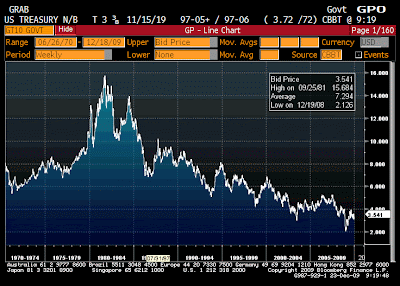
10-Year Treasury Yield

Source: Bloomberg
First, some basic facts:
The Treasury issued $1.7 trillion of securities on a net basis (meaning that total issuance exceeded the amount of securities maturing by that amount) in fiscal year 2009 and expects to borrow a net of $1.5 to $2.0 trillion in the current fiscal year, as the cumulative amount of budget deficits over the next three fiscal years is estimated to be in the area of $3.5 trillion. By all standards, these are staggering numbers.
Since the beginning of the decade, the average maturity of the Treasury's outstanding debt has dropped from about 70 months to approximately 50 months recently, as a result of appreciably heavier reliance on short-term debt issuance over medium- and longer-term maturities for most of that period. The most recent such level represents the lowest since the early '80s.
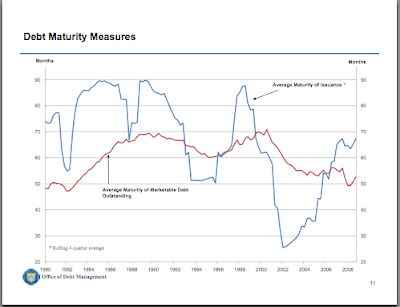
In announcing that decision, in the context of the quarterly press conference unveiling its broader financing plans, the Treasury went at great lengths to emphasize that the project of lengthening the average maturity of its debt would be implemented very gradually to avoid disrupting market expectations and breaking abruptly with past patterns. Still, a target of reaching an average of 60 months in fiscal 2010 was stated, with an eye on extending it to 84 months over the medium-term, which would represent a historical high.
The Treasury's decision to extend the average maturity of its debt is a sound one, not only on the grounds of prudent borrowing management by spreading out its debt burden over a longer horizon but also on the count of reducing its borrowing costs over time. The latter rationale has generally been a sensitive issue for the Treasury over the years, as it has always maintained that it is not in the business of attempting to "time the market" by adopting views on the future direction of interest rates- an overall sensible approach for a government.
Still, taking advantage, in a measured way, of the unusually low levels of long-term yields (courtesy of a severe financial crisis and associated economic recession) to implement a solid debt management principle of better balancing the ratio of short- to long-term outstanding debt makes perfect sense. Inasmuch as the Treasury wants, understandably, to stay clear of the hazardous enterprise of predicting interest rates, ignoring completely a historical opportunity that would allow it to materially reduce its interest costs on a mushrooming debt over the medium-term would be almost tantamount to malpractice.
Anthony Karydakis

In announcing that decision, in the context of the quarterly press conference unveiling its broader financing plans, the Treasury went at great lengths to emphasize that the project of lengthening the average maturity of its debt would be implemented very gradually to avoid disrupting market expectations and breaking abruptly with past patterns. Still, a target of reaching an average of 60 months in fiscal 2010 was stated, with an eye on extending it to 84 months over the medium-term, which would represent a historical high.
The Treasury's decision to extend the average maturity of its debt is a sound one, not only on the grounds of prudent borrowing management by spreading out its debt burden over a longer horizon but also on the count of reducing its borrowing costs over time. The latter rationale has generally been a sensitive issue for the Treasury over the years, as it has always maintained that it is not in the business of attempting to "time the market" by adopting views on the future direction of interest rates- an overall sensible approach for a government.
Still, taking advantage, in a measured way, of the unusually low levels of long-term yields (courtesy of a severe financial crisis and associated economic recession) to implement a solid debt management principle of better balancing the ratio of short- to long-term outstanding debt makes perfect sense. Inasmuch as the Treasury wants, understandably, to stay clear of the hazardous enterprise of predicting interest rates, ignoring completely a historical opportunity that would allow it to materially reduce its interest costs on a mushrooming debt over the medium-term would be almost tantamount to malpractice.
Anthony Karydakis
Thursday, December 17, 2009
The Undervalued Yuan: And Then There Was Silence
In the early part of the decade, it was a routine occurrence for both U.S. administration officials and politicians in Congress to criticize China's longstanding practice of keeping its currency undervalued by way of pegging it to the dollar. In July 2005, China officially de-linked the yuan from the dollar and let it appreciate by about 20% in the next three years to about 6.83 from approximately 8.3 previously. Still, since July 2008, the yuan has, for all intents and purposes, been tied to the dollar again and remained steady around 6.83. As the dollar has lost approximately 10% of its value on a trade-weighted basis since early March of this year, the yuan has also loyally followed the dollar in its slide.
Still, these days, no loud voices are raised among U.S. officials about the overt manipulation of the currency of a country that continues to run a massive trade surplus. In fact, Congress seems to have decidedly backtracked from its drive of a few years ago to put pressure on the Administration to brand China as a currency manipulator. Instead, it appears that it is increasingly the Europeans that are now taking the lead in putting pressure on China to let the yuan appreciate in accordance with its strong underlying fundamentals.
In a trip to Beijing earlier this month, a group of senior EU officials, which included the ECB President, made strongly the case to the Chinese leadership that it is beneficial for both China and the rest of the global economy to let the yuan strengthen. That was the second time in the last two years that EU officials have tried, publicly- and, presumably, in private as well- to exert pressure on China's top leadership to allow for a more realistic realignment of the yuan vis-a-vis other major currencies.
The euro area's concern over the strengthening of its own currency against the U.S. dollar this year has been frequently, and unmistakably, communicated by the ECB President in the last couple of months, as it has been identified as a headwind for the region's fledgling economic recovery. The fact that the euro is at the same time strengthening by a proportionate amount against the yuan as well, obviously compounds those concerns.
The issue for the euro zone's uneasiness over the undervalued yuan in this phase of the cycle is probably less driven by the more narrow issue of the loss of price competitiveness of its exports to China itself, as its trade volume with that country represents only a modest percentage of the region's total exports. Moreover, the euro area's combined export sector is only about 15% of the total GDP of the 16 countries involved, which suggests that, inasmuch as it would certainly be beneficial for the euro area's tenuous recovery to get the most contribution from every possible component of its GDP, exports will probably not be the defining force for the prospects of that recovery.
The true reasons for Europe's anxiety over the strengthening of the euro against both the dollar and the yuan are related to concerns that a) a period of prolonged strength of the first may undermine the long-term competitiveness of the euro-zone's export-oriented manufacturing sector, which represents close to 20% of its total output, and, b) it may hurt somewhat disproportionately the prospects of Germany's economic recovery in particular, given that country's heavy reliance on exports (accounting for close to half of its GDP, including exports to other euro-zone countries). Germany is of course the pivotal economy for the entire euro area.
In comparing the silence of the U.S. recently toward the artificially undervalued yuan, one cannot avoid thinking that the growing dependence on the Chinese as a major investor in U.S. Treasury securities in an environment of skyrocketing budget deficits has been a factor in taming such voices of protest. This willingness to cultivate a close relationship with a reliable creditor-nation was evident earlier in the year when China's leaders requested assurances from the U.S. President that the country's debt will not be downgraded in view of the massive new issuance of securities; not too long afterwards, Obama did oblige, offering such reassurances in public.
While it is true that the sheer size of China's foreign official reserves also leave that country with few good alternatives to the U.S. Treasury market (which offers a unique degree of liquidity and depth that are of critical importance to any major investor on such scale), it is also true that it would be a particularly destabilizing development that could roil global investors and the U.S. Treasury securities market specifically, to see the two countries relations becoming strained in public over any overt criticism of China's currency manipulation practices.
It is undoubtedly that same need to sustain a seemingly cooperative and fairly harmonious relationship with China on the economic front that has also led the U.S. in recent years scale back dramatically, to the point of non-existence, its previous repeated criticism of that country's human rights record. Not much is heard these days about that either and it is not because of any signficant improvement of that record in the last few years..
At the same time, the Europeans, that are not particularly prone to grandstanding on human rights rhetoric around the world (preferring, instead, to adopt more pragmatic positions and solutions) and are also free of any dependence on China's debt financing prowess, now seem to be the only ones with room to continue pressuring the Chinese on the thorny issue of the undervalued yuan.
Anthony Karydakis
Tuesday, December 15, 2009
A certain Senator from Connecticut
It is hard to turn on the TV or pick up a somewhat legitimate newspaper in the last 48 hours without coming face-to-face with the vaguely sinister grin of a certain Senator from Connecticut, who is at the epicenter of the entire health care reform bill under debate in Congress. The grin is of the "I know I hold all the cards and with a snap of my fingers I can decide whether the whole health care agenda lives or dies" kind.
This Senator is an unsuccessful Vice Presidential candidate in 2000, a miserably failed presidential candidate in 2004, and a defeated candidate in the primary contest of the Democratic party for re-election in the Senate in 2006. An experienced psychologist would be inclined to meticulously trace the origins of that grin to a massive pent-up resentment from all of these three races over the last nine years.
That grin, and its associated hard-nosed obstructionist and uncompromising attitude, is also linked to the fact that he also happens to be the second largest recipient of insurance industry contributions, having received more than 1 million dollars since 1998, according to today's New York Times. Resentment plus the serious need to earn his pay from the "all-too-kind" to him insurance lobby make for a potent motivation to drive a mean, "I now take my revenge on everyone who has repudiated me over the years" type of bargain with the Democratic majority in the Senate.
But, this particular Senator does actually have the whole world at his feet right now and he relishes that immensely. He holds even the current version of a watered-down, meek health care reform project, hostage to his whims.
It is not a classic reflection of the sad state of politics in this country.
It is simply sad.
Anthony Karydakis
Sunday, December 13, 2009
As Lending Continues to Shrink...
Bank lending continued to decline in the most recent period for which data are available, that is the July to September quarter. Loan balances were off by 3%, which represents the biggest quarterly decline since such data started being reported in 1984. Large banks, which have been the primary recipients of the bailout funds, accounted for 75% of that decline.
This is hardly surprising, in view of extensive anecdotal evidence and repeated qualitative assessments of credit conditions by the FOMC in its most recent statements as "tight". Still, there are a couple of intriguing points that spring out of this continuing trend.
1) Until earlier in the year, with the economy marred in a debilitating recession and with both household as well as capital spending in a major retreat, it was hard to disentangle the degree to which the distinctly weak lending patterns reflected the dire state of the banking system from the naturally weak demand for lending during such a period. But with personal spending rising by healthy 2.9% annual rate in Q3 and private fixed investment turning modestly positive (capital spending itself was off again- albeit by the smallest amount since Q2 2008), it is now clear that the significant turnaround of economic conditions in Q3 was not associated with an increased willingness of banks to lend more. In other words, the reluctance of banks to lend remains deeply entrenched even in the face of a presumed improvement in the demand for credit.
2) The above suggests that the sharp pick-up in consumer spending is being financed either by the increased in household wealth resulting from the stock market rally or by a decrease in the savings rate. Although the latter was not evident yet in the October data (the rate was off only by an inconsequential 0.2% to 4.4% in that month, which represents the most recently reported figure for that series), a strong likelihood exists that the improvement in personal consumption will be increasingly relying on a decline in the saving rate.
This would shatter the expectations in some quarters that the traumatic experience of the latest recession may be leading to a new paradigm in the U.S. economy, where consumers save a higher percentage of their current income. With bank lending activity unlikely to return to normal levels for some time, employment and income growth on track for only a gradual pace improvement ahead, and pent-up household demand waiting to be fullfilled, a downtrend in the saving rate over the next 9 to 12 months remains a distinct probability.
Anthony Karydakis
Thursday, December 10, 2009
A Propos Greece's Troubles
The precarious shape a number of euro-zone economies have found themselves in recently has dominated financial market headlines in the last few days. Ireland, Spain, and Greece seem to have joined other "second-tier" European countries, like Latvia and Hungary, in experiencing widespread loss of confidence in the quality of their sovereign debt. The draconian measures to address the budget gap that the Irish government announced yesterday have received an initially positive response but uneasiness over their effectiveness remains high.
http://online.wsj.com/article/SB126039835690184387.html
http://online.wsj.com/article/SB10001424052748704825504574586410597112166.html
At the core of the attention-getting developments of the last few days is the massive budget deficits and total amount of debt that these countries have accumulated, mostly, but not exclusively, due to the financial crisis and global economic downturn of the last two years. Although, it is actually unlikely that a euro-zone country, like Greece (which is facing the most serious problems) will be allowed by the EU to default on its debt- with Angela Merkel reminding investors as much earlier today-credit default swaps have soared.
A few thoughts.
a) The reassurance offered by the powers-that-be in the euro-system about offering help to its members currently in trouble is obviously a positive development, but it may not be enough to resolve the issue. Greece is already resisting EU pressure to implement any major belt-tightening measures of its own as politically untenable and offers only promises of bringing its budget deficit from 12.7% of GDP this year to about 10% next year. That is likely to be viewed as a frustratingly slow pace to many. Against such obstinacy, it may not be too far down the line, where massive bets against the country's ability to contain its debt burden start being placed by global macro hedge funds- not totally unlike those that were already pushing Iceland (a non-euro zone country) against the wall as the financial crisis was erupting in 2008. (In fact the second of the above links describes exactly those emerging strategies by some). This would represent a major complication for any bail-out efforts by the EU.
2) Directly linked to the above point, the problems that Greece and Spain are facing- and, possibly, Ireland, Italy, and Portugal to various degrees- are not solely the result of the size of their budget deficits per se but more of the lack of credibility that those countries have in the eyes of global investors in terms of their determination to bring them under control. For example, Germany's budget deficit is surpassing 6% of GDP this year but Germany's sovereign debt still carries some of the lowest rates in the euro area and credit default swaps on such debt have not budged. Nobody questions Germany's commitment to reining in the deficit as economic growth picks up into next year. Of course, another key differentiating factor is the total amount of debt of the various countries involved, with Greece's exceeding 125% of its GDP, while other healthier euro-zone economies are only moderately exceeding the 60% cap mandated by the "growth and stability" pact.
3) In a way, the current predicament of the three main countries in trouble currently represents the moment of reckoning for reckless and short-sighted policies earlier in the decade, mostly driven by a goal of creating an aura of unusual prosperity largely built on sand (Ireland, Greece). The financial crisis and associated economic downturn simply helped expose the underlying fault lines of such growth.
4) Finally, it is tempting to highlight that there has been a reversal of past patterns and prevailing stereotypes as to the resiliency that different economies around the world demonstrate in the face of global financial market events of extreme stress. While emerging market economies used to be considered "high-risk" in such situations- and there is admittedly a long history of defaults on their debt to support that perception- it has been exactly those economies that have weathered best the financial turmoil of the last two years. Even Argentina, a serial offender in terms of defaulting on its debt in the last 30 years, is taking positive steps opening up its access to international capital markets again, by announcing today a decision to swap out of $20 billion of defaulted debt.
http://online.wsj.com/article/SB126039835690184387.html
http://online.wsj.com/article/SB10001424052748704825504574586410597112166.html
At the core of the attention-getting developments of the last few days is the massive budget deficits and total amount of debt that these countries have accumulated, mostly, but not exclusively, due to the financial crisis and global economic downturn of the last two years. Although, it is actually unlikely that a euro-zone country, like Greece (which is facing the most serious problems) will be allowed by the EU to default on its debt- with Angela Merkel reminding investors as much earlier today-credit default swaps have soared.
A few thoughts.
a) The reassurance offered by the powers-that-be in the euro-system about offering help to its members currently in trouble is obviously a positive development, but it may not be enough to resolve the issue. Greece is already resisting EU pressure to implement any major belt-tightening measures of its own as politically untenable and offers only promises of bringing its budget deficit from 12.7% of GDP this year to about 10% next year. That is likely to be viewed as a frustratingly slow pace to many. Against such obstinacy, it may not be too far down the line, where massive bets against the country's ability to contain its debt burden start being placed by global macro hedge funds- not totally unlike those that were already pushing Iceland (a non-euro zone country) against the wall as the financial crisis was erupting in 2008. (In fact the second of the above links describes exactly those emerging strategies by some). This would represent a major complication for any bail-out efforts by the EU.
2) Directly linked to the above point, the problems that Greece and Spain are facing- and, possibly, Ireland, Italy, and Portugal to various degrees- are not solely the result of the size of their budget deficits per se but more of the lack of credibility that those countries have in the eyes of global investors in terms of their determination to bring them under control. For example, Germany's budget deficit is surpassing 6% of GDP this year but Germany's sovereign debt still carries some of the lowest rates in the euro area and credit default swaps on such debt have not budged. Nobody questions Germany's commitment to reining in the deficit as economic growth picks up into next year. Of course, another key differentiating factor is the total amount of debt of the various countries involved, with Greece's exceeding 125% of its GDP, while other healthier euro-zone economies are only moderately exceeding the 60% cap mandated by the "growth and stability" pact.
3) In a way, the current predicament of the three main countries in trouble currently represents the moment of reckoning for reckless and short-sighted policies earlier in the decade, mostly driven by a goal of creating an aura of unusual prosperity largely built on sand (Ireland, Greece). The financial crisis and associated economic downturn simply helped expose the underlying fault lines of such growth.
4) Finally, it is tempting to highlight that there has been a reversal of past patterns and prevailing stereotypes as to the resiliency that different economies around the world demonstrate in the face of global financial market events of extreme stress. While emerging market economies used to be considered "high-risk" in such situations- and there is admittedly a long history of defaults on their debt to support that perception- it has been exactly those economies that have weathered best the financial turmoil of the last two years. Even Argentina, a serial offender in terms of defaulting on its debt in the last 30 years, is taking positive steps opening up its access to international capital markets again, by announcing today a decision to swap out of $20 billion of defaulted debt.
It is now, countries in the heart of Europe that are facing a particularly bleak predicament that represents a significant challenge for the cohesiveness of the euro system and testing the limits of patience of global investors.
All in all, another strong reminder, following Dubai's recent problems, that, although the global financial crisis has been by and large successfully contained, pockets of extreme fragility have been left behind and are not likely to disappear any time soon.
Anthony Karydakis
All in all, another strong reminder, following Dubai's recent problems, that, although the global financial crisis has been by and large successfully contained, pockets of extreme fragility have been left behind and are not likely to disappear any time soon.
Anthony Karydakis
Tuesday, December 8, 2009
No Deflation Ahead
A number of influential, and legitimate, voices- including the Fed Chairman and PIMCO- have been raised recently to the effect that they expect the pace of the U.S. economic recovery to be a very moderate one. Although, the term "moderate" is a qualitative one and is probably used by Bernanke and PIMCO having different numbers attached to it, most of those who subscribe to that view are also calling for inflation to continue drifting lower over the next year or two, with some actually raising the specter of deflation as a result (see also a previous post titled "PIMCO's Bet").
Given that inflation is a lagging indicator and there is a considerable amount of inertia associated with its behavior, anticipating a further downward drift in the pace of price increases over the next year (particularly in regards to core inflation) is reasonable; promoting the view though that deflation is a plausible risk in the context of an unfolding expansionary period begs some further explanation.
Irrespective of such diverse views on the price outlook however, a down-to-the-earth look at some key measures of inflation expectations reveals an entirely different view.
After collapsing in the fall of 2008, overwhelmed by pervasive fears of a banking system disaster and a major, depression-like, economic downturn, TIPS break-evens (the spread between nominal Treasury yields and the yield on Treasury inflation-protection securities, which implies the expected rate of inflation over the investment period) have been widening steadily since the beginning of the year. This reflects underlying expectations that the overall CPI is likely to be returning to its recent historical averages of about 2%-2.5%, in the years ahead. In fact, both the 5- and 10-year break-evens currently stand very close to their levels prior to the Lehman episode in September 2008 (see below).
5-year TIPS Break-evens

Source: Bloomberg
10-year TIPS Break-evens
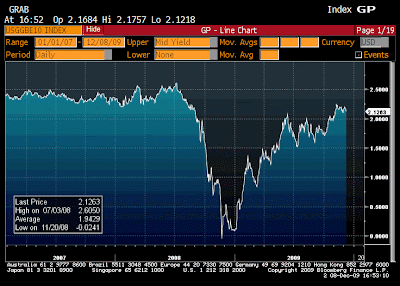
Source: Bloomberg
Simply put, the restoration of these spreads to pre-crisis levels, reflects the belief that the worst of the banking crisis is behind us and that the economy is recovering at a sufficient pace (irrespective of what specific number, or additional qualitative adjective, is attached to it) to ensure the gradual return of inflation to trend. As one would have expected the implied rate of inflation expectations over the 5-year horizon is somewhat lower than the one over the 10-year horizon, as the weight of 2010 (when inflation should remain especially weak) is obviously greater in a 5-year period as opposed to a 10-year one.
Another, fairly closely watched but admittedly "soft", gauge of inflation expectations is the "5- to 10-year inflation expectations" component of the University of Michigan Consumer Sentiment Survey, which continues to hover around the 3% mark in recent months. This is somewhat higher than the anticipated rate of inflation reflected in the TIPS break-evens, which is to be expected, as consumers' perception of inflation is typically associated with a higher number than the one officially measured by the CPI. On that score, it is worth recognizing that even the "short-tern inflation expectations" component of the University of Michigan survey (representing a 1-year horizon) is also anchored just below 3%.
Somewhat unscientific as these consumer inflation expectations measures may be, they still corroborate the financial market's fairly more rigorous perceptions of the price outlook and they certainly betray no uneasiness over any prospect of deflation, which, at the margin, could make the latter a self-fulfilling prophecy of sorts.
Deflation, as a trend and not as a short-lived quirk of year-on-year comparison in the various price statistics, is a phenomenon very hard to come by and Japan is the only major industrialized country to have experienced it in recent history- largely as a result of a double meltdown in its stock markets and banking system in the 90s and a notoriously slow policy response to address it. But both of these two potentially extremely destabilizing dynamics seem to have been contained in the U.S. at the present and, as a result, have convincingly pushed the risk of deflation to the sidelines.
5-year TIPS Break-evens

Source: Bloomberg
10-year TIPS Break-evens

Source: Bloomberg
Simply put, the restoration of these spreads to pre-crisis levels, reflects the belief that the worst of the banking crisis is behind us and that the economy is recovering at a sufficient pace (irrespective of what specific number, or additional qualitative adjective, is attached to it) to ensure the gradual return of inflation to trend. As one would have expected the implied rate of inflation expectations over the 5-year horizon is somewhat lower than the one over the 10-year horizon, as the weight of 2010 (when inflation should remain especially weak) is obviously greater in a 5-year period as opposed to a 10-year one.
Another, fairly closely watched but admittedly "soft", gauge of inflation expectations is the "5- to 10-year inflation expectations" component of the University of Michigan Consumer Sentiment Survey, which continues to hover around the 3% mark in recent months. This is somewhat higher than the anticipated rate of inflation reflected in the TIPS break-evens, which is to be expected, as consumers' perception of inflation is typically associated with a higher number than the one officially measured by the CPI. On that score, it is worth recognizing that even the "short-tern inflation expectations" component of the University of Michigan survey (representing a 1-year horizon) is also anchored just below 3%.
Somewhat unscientific as these consumer inflation expectations measures may be, they still corroborate the financial market's fairly more rigorous perceptions of the price outlook and they certainly betray no uneasiness over any prospect of deflation, which, at the margin, could make the latter a self-fulfilling prophecy of sorts.
Deflation, as a trend and not as a short-lived quirk of year-on-year comparison in the various price statistics, is a phenomenon very hard to come by and Japan is the only major industrialized country to have experienced it in recent history- largely as a result of a double meltdown in its stock markets and banking system in the 90s and a notoriously slow policy response to address it. But both of these two potentially extremely destabilizing dynamics seem to have been contained in the U.S. at the present and, as a result, have convincingly pushed the risk of deflation to the sidelines.
Further disinflation is a plausible outcome in the foreseeable future, but much to the likely disappointment of the merchants of doom, deflation is not.
Anthony Karydakis
Anthony Karydakis
Friday, December 4, 2009
The Employment Picture Brightens Up Suddenly, In a Major Way
Labor market conditions continue to improve at a fast clip and the November employment report provided strong confirmation of that trend. This conclusion is not based on the decline in the unemployment rate to 10.0% from 10.2% (a nearly inevitable correction from a curiously sharp jump of the rate in October) but on a consistent message from just about every major aspect of the data.
It is not only that November's decline in payrolls was a mere 11,000 but, even perhaps even more importantly, there was a massive net cumulative upward revision of 159,000 in the payroll data for the prior two months. The result is a dramatically different profile of recent payroll trends, showing a faster improvement than previously thought. Payroll declines in the last 3 months have averaged 87,000 a month versus average declines of 307,000 in the preceding 3-month period and -491,000 in the 3-month period prior to that.
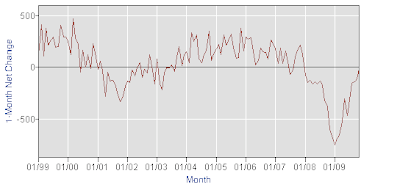
Source: Bureau of Labor Statistics
Adding impetus to the impressive strength of the report- compared to the relatively recent past- the average workweek rose to 33.2 hours from its cycle-low of 33.0 hours. Any moderate sustained rise in the workweek is usually viewed as a precursor of more hiring down the line, as there are limits as to how intensively employers can utilize their existing labor force before adding to it. The manufacturing workweek also jumped by 0.3 hours to 40.4, supporting evidence of a significant turnaround in that sector, as manifested by the ISM and other manufacturing surveys in recent months.
Both construction and manufacturing employment fell last month, by 27,000 and 41,000 respectively, but these are two sectors unlikely to become significant sources of job creation in the foreseeable future, as construction is likely to remain in deep freeze for some time and the bulk of increased output in manufacturing recently comes from a rise in productivity. It is also a sign of the ongoing caution that employers are still exercising in terms of hiring that temporary jobs rose by 57,000 in November and have increased by a total 117,000 since July.
However, all of the still present pockets of weakness in the payroll data need to be understood in the context of the dynamic that prevails around turning points of the cycle- meaning that not all sectors will be showing the same measure of improvement simultaneously and this is likely to be particularly true this time in view of the severity of the last recession and the major dislocations it has caused.
With the pace of layoffs slowing precipitously in the last several weeks, as measured by a strong downtrend in initial unemployment claims, monthly payroll data are poised to start turning positive in the coming months. In fact, the most reasonable expectation at this point is that by early next year, we will start seeing modest to moderate monthly gains, while the unemployment rate may continue to linger around its cycle-highs. But today's report, along with the totality of the other pieces of economic data recently, suggests that the impetus that this economic recovery is having may have been seriously underestimated.
Anthony Karydakis
It is not only that November's decline in payrolls was a mere 11,000 but, even perhaps even more importantly, there was a massive net cumulative upward revision of 159,000 in the payroll data for the prior two months. The result is a dramatically different profile of recent payroll trends, showing a faster improvement than previously thought. Payroll declines in the last 3 months have averaged 87,000 a month versus average declines of 307,000 in the preceding 3-month period and -491,000 in the 3-month period prior to that.

Source: Bureau of Labor Statistics
Adding impetus to the impressive strength of the report- compared to the relatively recent past- the average workweek rose to 33.2 hours from its cycle-low of 33.0 hours. Any moderate sustained rise in the workweek is usually viewed as a precursor of more hiring down the line, as there are limits as to how intensively employers can utilize their existing labor force before adding to it. The manufacturing workweek also jumped by 0.3 hours to 40.4, supporting evidence of a significant turnaround in that sector, as manifested by the ISM and other manufacturing surveys in recent months.
Both construction and manufacturing employment fell last month, by 27,000 and 41,000 respectively, but these are two sectors unlikely to become significant sources of job creation in the foreseeable future, as construction is likely to remain in deep freeze for some time and the bulk of increased output in manufacturing recently comes from a rise in productivity. It is also a sign of the ongoing caution that employers are still exercising in terms of hiring that temporary jobs rose by 57,000 in November and have increased by a total 117,000 since July.
However, all of the still present pockets of weakness in the payroll data need to be understood in the context of the dynamic that prevails around turning points of the cycle- meaning that not all sectors will be showing the same measure of improvement simultaneously and this is likely to be particularly true this time in view of the severity of the last recession and the major dislocations it has caused.
With the pace of layoffs slowing precipitously in the last several weeks, as measured by a strong downtrend in initial unemployment claims, monthly payroll data are poised to start turning positive in the coming months. In fact, the most reasonable expectation at this point is that by early next year, we will start seeing modest to moderate monthly gains, while the unemployment rate may continue to linger around its cycle-highs. But today's report, along with the totality of the other pieces of economic data recently, suggests that the impetus that this economic recovery is having may have been seriously underestimated.
Anthony Karydakis
Wednesday, December 2, 2009
In Praise of the Bernanke Fed
(Fair warning: This is a long article. It requires more than 20 seconds to read it!)
It certainly feels as if the favorite game among members of Congress these days is to outbid each other in trying to limit the various aspects of the Fed's powers and independence. The underlying reason is both transparent and cynical, all blended with a strong hint of ignorance.
Playing the populist card in attempting to show how outraged they are too by Wall Street's bailout in the midst of the financial crisis, while Main Street was left holding the bag (also known, as the bailout cost), people in Congress are focusing their criticism on the Fed. Such criticism has flared up in recent days, with Bernanke's own confirmation hearings underway and various bills designed to overhaul the bank regulatory framework making their way through Congressional committees.
That rising level of attacks on the Fed, and the implied threat to its regulatory and monetary policymaking authority, prompted the Fed Chairman to write an article in The Washington Post this past weekend, offering a spirited defense of the Fed's independence and crucial leadership role that it should continue to play in the context of any regulatory overhaul.
The main arguments of those who cannot criticize the Fed quickly enough are three:
a) The Fed, as a bank regulator and supervisor, did a very poor job at recognizing the steadily growing risks to the financial system that led up to its near-meltdown following Lehman's demise.
b) The Fed was at the forefront of the drive to bailout the major financial institutions once the crisis erupted, although it was precisely those same institutions that, by way of their reckless and dubious behavior, were responsible for the financial crisis itself.
c) It is unacceptable in a "democratic society" for the Fed to have so much power and independence from both the executive and legislative branches of the government; therefore, it needs to be brought under more supervision and some of its powers to be taken away.
The first of the above points can be disposed of fairly easily, by admitting that indeed the Fed did a miserable job at identifying the build-up to the financial crisis and had shown little interest in trying to rein in the tremendous proliferation of exotic derivative instruments for the most part of the decade. Although the bulk of of this failure should -out of fairness- be assigned to Greenspan's irrepressibly free-market, hands-off, philosophy, there is no dispute over the Fed's, as an institution, embarrassing failure here. Bernanke plainly acknowledges this in his article and highlights a number of concrete measures the Fed has taken recently to prevent such an enormous lapse again in the future, like beefing up bank examiners' teams, tightening the supervision practices etc. One can raise questions as to how effective these measures will be in correcting the problem but there is little reason to believe that another regulator would, for some unexplained reason, be more nimble and effective in dealing with such problems.
The second of the above points is where a giant misconception and a good dose of hypocrisy by the Fed's Congressional critics merge. The bailout of "Wall Street" was not an elective action but borne out of necessity to prevent the collapse of the entire financial system, which would have had unspeakable consequences for Congress's favorite constituency- the "Main Street". As Bernanke had pointed out at one point during the heady days of the crisis, you don't let a whole neighborhood burn down to punish the arsonist who may live in that neighborhood himself; you first put out the fire any way you can and then try to deal with the arsonist.
The whole idea that, somehow, the major financial institutions should have been allowed to collapse because we didn't want to burden the Main Street with the cost of keeping them alive enters squarely into the sphere of absurd. Someone in Congress should perhaps find the time, and courage, to explain to that famous "average American on the street" that this is the way the capitalist system that they all learn to worship from kindergarten on really works. It is based on the unspoken pact that when the financial industry does well, those that are part of it get obscenely compensated for their spirit of "entrepreneurship" and "willingness to take risk". Rewarding success is the ultimate value in the society and no one is complaining.
But, when the industry suffers a life-threatening heart attack (irrespective of whether it is due to its own fault or that of others), and threatens to plunge the economy and global financial system into an abyss, the only available course of action is to frantically try to resuscitate it at all costs. And, given the close symbiotic relationship that Congress, the Executive branch, and corporations enjoy in the brand of unfettered capitalism in this country, the cost of salvaging the financial system will naturally need to be borne by those who can be forced to do so- that is the Main Street. It is a pity, and arguably a high point of hypocrisy, that no one has explained to the "average person on the street" how the true free-market system is really meant to work- not on paper, but in reality. Otherwise, extensive government intervention to meaningfully rein in the systemically dangerous greed of the system is quickly labeled as "socialism" which, again, in the eyes of the Main Street is probably far more abhorrent than Wall Street.
On that last seemingly unfair issue, the Bernanke Fed has actually been at the forefront of supporting a provision in the proposed overhaul of the regulatory system, according to which all major financial institutions will be required to pay a premium to a special fund to cover the cosy of any such bailouts in the future. An innovative and sensible idea, although its final version, if enacted at all, will probably be watered down appreciably. But, at least, the Fed is showing tangible signs that they are drawing some sensible conclusions from the crisis.
And, then, there is the paramount issue that those who savage the Fed's role in the recent banking crisis either ignore or are simply unable to appreciate.
The Fed's response to the crisis was phenomenally aggressive, imaginative, and, ultimately, effective in preserving the financial system's integrity. They invented an array of new tools on the fly to combat the crisis, they turned traditional monetary policymaking at times on its head, they assumed some major risks. The Bernanke Fed's response to the events of the post-Lehman period will probably be studied at all major Business Schools around the country (and beyond) 30, 40 years, or more, from now. The determination and swiftness that the Fed showed during that period have already become part of the global finance's history books. It is ironic that against that backdrop some of the nation's elected representatives now profess outrage by the Fed's role in the financial crisis. Ignorance can be their best excuse, but still...
As for the third argument used by Bernanke's critics, that the Fed is too unaccountable for the amount of power that it wields within the entire financial system, that "power" needs to be broken down into its two key components:
On the count of conducting monetary policy independently, it would require an enormous amount of bad faith to argue that it is best to subject such decisions to direct influence by either the executive or the legislative branches of the government and bring them under the control of people that would give priority to short-term political expediency objectives rather than the Fed's long-term goals of sustainable economic growth and price stability. On the count of the Fed's becoming more transparent in the way it operates, this is probably one of the major prevailing misconceptions about the Fed. As Bernanke's article points out, he personally delivers several lengthy Congressional testimonies each year answering questions at great length, the Fed's balance sheet is regularly audited, the Fed provides monthly detailed reports about its various special facilities, and the FOMC always announces in detail its decisions regarding monetary policy. A transparency problem?
Perhaps, it's time for those who do actually have a better understanding than some in Congress of how the Fed operates and what its role exactly was in the recent financial crisis, to stand up and defend the Fed and its independence.
The financial system is still standing today, and Ben Bernanke may be the single most important reason for that.
Anthony Karydakis
Monday, November 30, 2009
The Message from Dubai
As the situation with Dubai and its investment arm, Dubai World, has nearly dominated the financial market headlines in the last several days, there are some important observation to be made:
1) Pockets of instability that can send ripples of anxiety across the global financial system still linger on, almost 15 months following the Lehman affair. Some of these pockets of potential trouble continue to fly under the markets' radar screen- as was the case with the Dubai episode- making them potentially more dangerous when they abruptly burst to the surface. In other words, we have now seen clearly that the global financial system remains prone to aftershocks.
2) The configuration of the various players affected by those aftershocks is not the same as in the previous major round of the crisis, or, at least, those players are not affected to the same degree. In the current Dubai affair, it appears that it is mostly the Britsh banks absorbing the brundt of the seemingly inevitable default by Dubai World, and particularly HSBC and the Royal Bank of Scotland. True, both of these institutions had been among those ravaged in the aftermath of Lehman's collapse, but one cannot but acknowledge that, this time, the major U.S. banks have stayed, mercifully, out of harm's way.
3) Despite its undeniable vulnerability, the global financial system is showing credible evidence of having healed considerably from its near-death experience late last year. Of course, credit-default swap prices on various countries' sovereign debt have risen since early last week and some stock markets around the world- particularly those with close geographical proximity to Dubai- have sold off. But, by and large, most major financial markets around the globe have continued to function properly, essentially casting a vote of confidence in their own ability to weather the storm. This takes particular significance today, after Dubai refused to come to the rescue of Dubai World's debt, essentially pushing the latter into restructuring.
The entire Dubai affair may help re-inject an element of caution toward some global spread products and sovereign debt of a number of other countries. It may even help complicate somewhat the economic recovery prospects in the U.K, the beleaguered banking system of which just took a fresh hit, and some banks on continental Europe may come under renewed pressure. Nobody argues that the world has become a perfectly safe place again, so soon after the harrowing experience of last year. But, financial markets and the global banking system, wounded as they may still be, are slowly regaining a sense of balance; and this is perhaps the key message from the Dubai story.
Anthony Karydakis
Monday, November 23, 2009
The Curious Case of Negative Yields
Certain Treasury bill rates briefly dipped into slightly negative territory in the last couple of days, which constitutes a pretty extraordinary phenomenon by any measure. This essentially means that investors are willing not only to forgo any interest on such holdings but are willing to pay in order to get their hands on Treasury bills that mature in January 2010.
Part of the reason for this highly unusual, and counter intuitive situation is of a somewhat technical nature and associated with an emotional reaction of the market to comments made by a Fed official late last week.
St. Louis Fed President James Bullard expressed the view that the Fed should keep its program of mortgage-backed securities purchases in effect beyond the currently planned time frame of March 2010 and also implied that, based on the pattern of how the Fed has reacted in past cycles, the central bank may refrain from tightening for as long as another two years. Although views expressed by individual Presidents of regional Federal Reserve Banks often do not reflect the FOMC's mainstream view, Bullard's comments triggered some excitement in the front end of the Treasury market, which, in turn, caused a scramble to close in a hurry any previously established short positions. The result was a wave of impulsive and technical buying that pushed yields briefly into below-zero territory.
However, there is something disconcerting about all of this insatiable demand for liquidity. At its core, lies the lingering fragility of the banking system and a strong need for institutions to fortify their balance sheet for year-end purposes with the safest-quality paper available. It is hard to forget that the only other such episode of negative Treasury bill yields in modern history occurred in December 2008 (and, in the case of the 1-month bill, in March of this year as well), right in the midst of the wave of anxiety and risk-aversion sweeping the financial system in the post-Lehman period. In this latest phase, bill rates had already been drifting lower in recent weeks, ultimately leading to the piercing of the zero percent level in the last couple of days.
The absence of any headline-making negative news about the financial system in the last few months is by no means tantamount to banking institutions' returning to an even passing semblance of soundness. Banks are still vulnerable, undermined by the vast majority of their toxic assets that they still carry on their balance sheet (despite a moderate rebound in some of the underlying markets), and the imperative for year-end, window-dressing operations remains as pressing as ever.
Anthony Karydakis
Friday, November 20, 2009
Global Growth Looking Up
In the latest set of economic forecasts issued by the OECD earlier in the week, the picture of the global economic recovery seems a little more upbeat compared to the prevailing view as recently as a few months ago. Not only do the OECD projections for the major economies are more optimistic than those issued by the IMF at the beginning of October, but they suggest- despite the appropriate cautionary notes attached to them- that a global recovery is indeed taking hold and likely to consolidate further over the 2010-2011 period.
http://www.oecd.org/document/18/0,3343,en_2649_33733_20347538_1_1_1_1,00.html
The OECD forecasts GDP growth of 2.5% in the U.S. next year, versus 1.5% growth predicted by the IMF in its early October projections, which, in turn, represented an upgrade compared to its own previous forecast of only 0.8% issued last July. In regards to the euro area, the OECD now expects growth of 0.9% in 2010 versus 0.3% in the IMF numbers- which, again, represents a 0.6% upward revision from its own previous forecast in July. As for Japan, both the OECD and the IMF's latest report see growth in the 1.7%-1.8% range for 2010. Finally, the OECD projections, perhaps more importantly, show a further pick up in growth for the U.S. and euro zone in 2011 to 2.8% and 1.7% respectively, which would essentially represent a return to growth rates close to the long-term trend for both economies.
Granted- forecasts are just that, forecasts, and they are a famously unreliable exercise, as experience has shown numerous times over the years. In fact, the OECD itself is quick to acknowledge substantial both downside and upside risks to those projections, which it deems to be roughly balanced. It furthermore, warns that the global recovery will still be relatively timid and unlikely to prevent a further rise in the unemployment rate in the main member-countries in the first half of 2010, before the rate stabilizes.
Still, it is hard to ignore the reality that in the spate of the last several months, there is an unmistakable upgrade in the degree of confidence around the world that a sustainable economic recovery is taking hold. As a result, predictions of a double-dip recession that were much "in vogue" earlier in the summer (particularly in the context of the U.S.) are now melting away quickly.
The reasons for the newly-found sense of credibility in the unfolding global economic recovery are multi-faceted but, essentially, interconnected.
China's impressive turnaround (expected to return solidly to double-digit growth rates in 2010) is pulling the rest of Asia- including Japan- higher. The resulting vigorous comeback of the Pacific Rim region acts as a potent "locomotive" for the rest of the world economy and shows that the U.S. economy is no longer the only one that can play that role on the global stage.
Another major factor underlying the emergence of somewhat more upbeat expectations in the last few months has to do with the increasingly accepted premise that the banking systems in the U.S. and euro area have survived the financial crisis of the last two years; still deeply wounded- appreciably more so in the U.S. than in the euro zone- but, ultimately, survived. The diminution of fears of a downward spiral of the banking sector that would leave those economies seriously limping on a protracted basis are now diminishing.
This is not to say that the fragile shape their banking sector remains in will not represent a key headwind preventing a more robust economic recovery ahead, both here and in the euro area. But this is likely to find a partial offset in the anticipated quick turnaround in global trade already underway, set into motion by a number of other major economies elsewhere in the world that are coming back on line, as their banking systems escaped the financial crisis practically unscathed (China, Brazil, Japan, India come to mind).
Perhaps this serves as a stark reminder that the center of gravity of the world economy is slowly slipping away from the U.S.-Europe axis in the last decade or so and this can have significant implications for the way global business cycles play out in the future. Emerging markets are no longer the passive recipients of a "ripple effect" originating in the traditional major economic powers, but they are now becoming a major counter-balancing force and an engine of stability in the context of global business cycles.
Anthony Karydakis
Tuesday, November 17, 2009
The Euro: Jean-Claude Trichet's Little Problem
After a deeply skeptical reception by global financial markets in the early years following its introduction in 1999, the euro is now almost universally viewed as a great success story. In fact, so much so that recently concerns are being raised in the euro-area that the impressive strength of its currency may become an impediment to the emerging economic recovery in that part of the world.
It is against that backdrop that, in an interview published in today's Le Monde, the ECB President, Jean-Claude Trichet, makes another earnest attempt to downplay the seemingly irrepressible appeal of the euro, by presenting it essentially as simply the currency of the countries representing 330 million people in Europe, that was never intended to replace the dollar as an international reserve currency.
As I have argued before in this space, Trichet is a brilliant and highly sophisticated central banker, whose modesty in regards to the role of the euro displayed in this interview can only be viewed as a desperate act of a desperate man. Unable to embark on a campaign of massive foreign exchange market intervention to bring the currency down, and confronted with the side-effects of its impressive rise, he is limited to making frequent public statements extorting the virtuous of a strong dollar (see: a lower euro) in recent months.
The trouble for Mr. Trichet is that he has done a phenomenally good job at steering the euro-zone's monetary policy in the last several years, which has helped cement the ECB's crdibility, by presenting to the world impeccable credentials of steadfastness, flexibility, and unwavering commitment to its infamous "single mandate" of price stability. As the ECB's credibility has reached the sphere of irreproachability in the eyes of global financial markets, the euro's appeal has been rising accordingly.
One has to wonder whether it had ever occurred to Mr. Trichet that the success in the ECB's 10-year-old struggle to establish both its own and the euro's credibility would ultimately result in the latter being viewed as a serious alternative to the dollar- and, therefore, considered as an appealing reserve currency. His pretention now that the ECB had not envisioned the euro as becoming an alternate vehicle for central banks' foreign reserves around the world sounds rather unconvincing. Still, his predicament is understandable, as, given the levels the euro is at currently, any sustained trend toward reallocation of foreign central banks' reserves in favor of the euro in the coming years could undermine the growth prospects in the euro-zone over the medium-term.
Still, there are reasons for Mr. Trichet to be encouraged that the latest rise of the euro will ultimately be contained, as the current levels are far from unprecedented. Foreign exchange markets, like any market, have cycles and currencies go up and down over time; for example, the euro hit a record 1.60 against the dollar in April 2008, only to retreat to 1.25 six months later and resumed its rise since February of this year. So, there is certainly reasonable hope that another cycle of retreat for the euro will ultimately kick in, as a result of the markets' natural dynamics. Although this would still not be addressing the issue of the longer-term trend for the currency, it would alleviate at least some of the immediate anxiety over its behavior.
Of course, Mr. Trichet always holds the ultimate weapon to address his concern over the strong euro; he can always mess up the ECB's monetary policy...and, badly so.
Anthony Karydakis
Sunday, November 15, 2009
The U.S. Trade Deficit: No Lasting Improvement
The size of the U.S. trade deficit since the beginning of the decade has been a source of concern and often identified by many as one of the most persistent and unsettling imbalances facing the U.S. economy. Throughout that period, the worst-kept secret among people in the broader field of macroeconomics has been that, pragmatically speaking, there is only one way we could reasonably expect to see a significant reduction in the trade deficit: a deep and prolonged recession.
The effectiveness of that "prescription" has now been tested and fully validated; in fact, at first glance, it has passed with flying colors. After totaling approximately $700 billion in both 2007 and 2008, the international trade balance of goods and services is now on track to be a little over half that amount in the current year. Differently put, average monthly deficit numbers close to $60 billion in 2007 and most of 2008 have been running at an average of $30 billion a month since the beginning of the year. While both exports and imports have suffered in the midst of the global economic downturn, imports have declined by 80% in the first nine months of 2009 versus a 62% drop in exports during that period- resulting in the dramatic improvement in the overall deficit.
While this certainly seems to be good news, there is not much encouragement one can derive regarding the prospects for the deficit over the medium-term. As the U.S. economy slowly exits its recession, and most other countries are recovering to various degrees, the U.S. trade deficit is bound to slowly deteriorate again over the next 12 to 24 months. In fact, to a considerable extent, that was the key message from last week's report on the September deficit, which widened sharply to $36.5 billion from $30.8 billion in August. As consumer spending picked up dramatically in the third quarter, so did imports. While a good part of the 5.8% surge in overall imports was due to a higher petroleum import bill and automotive imports related to the cash-for-clunkers program, the reality is that the spectacular improvement that the deficit showed in the first half of the year- averaging $27.7 billion a month between February and June, at the depth of the recession- is already behind us and a partial reversal of that process is already underway as the U.S. economy recovers.
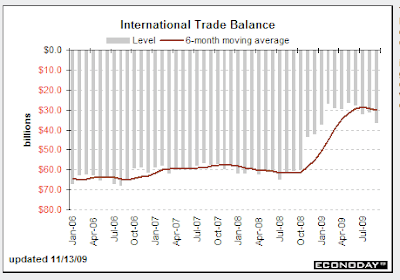
Source: Bloomberg, Haver Analytics
The moderate overall decline of the dollar on a trade-weighted basis since February has often been mentioned as a key factor for this year's improvement in the trade deficit so far. However, this is unlikely to have been a crucial factor. There are significant lags between the time a sustained decline in the value of a currency takes place and its impact on the trade balance of that country; these two forces are not contemporaneous, as pre-existing pricing contracts in international trade remain in effect for a while- irrespective of changes in the exchange rates involved in the interim- until the time comes for such contracts to be renegotiated. Given that the dramatic improvement in the trade numbers occurred in the period between November 2008 (prior to the start of the dollar's slide) and June 2009, it is unlikely that the weaker dollar has been an appreciable factor so far.
The lower dollar will be somewhat helpful in containing the amount of deterioration that the U.S trade deficit is likely to suffer over the next twelve months. Once again, though, that factor should not be overestimated as the dollar may recoup some of its lost ground in 2010, when the Fed starts being viewed as approaching the time when they will be doing away with the zero short-term rate policy.
This leaves the pace of the U.S. economic recovery, particularly compared to the rest of the world, as the key determinant of the direction of the trade deficit from here. While the U.S. recovery may be somewhat choppy and of the historically moderate kind, the same is likely to be the case for at least two of our key trading partners: Euro zone and Japan; so, not much relief on that front.
Given a) the heavy pent-up demand that has been created in the last 18 months or so in the U.S. in the midst of a particularly scary economic and financial market environment, b) the fact that a stabilization of labor markets (with encouraging signs of further improvement in the "pipeline") is already underway, paving the way for a pick-up in consumer spending, and c) that personal consumption represents a whopping 70% of the U.S. economy, the most likely outcome of all of this is that a sustained increase in the demand for imports will cause the trade deficit to deteriorate moderately again in 2010. The stronger the economic recovery turns out to be, the wider the deficit should get. It would not return quickly to pre-recession levels, but it will probably move closer to the $450 billion plus range next year, compared to $375 billion or so this year.
So, the recession will turn out to have been not a real "cure" for the trade deficit but rather a short-acting medicine of sorts. The true cure would be a fundamental reorientation of the U.S. economy away from spending and toward more saving- a prospect that does not look very promising at all.
Anthony Karydakis
The effectiveness of that "prescription" has now been tested and fully validated; in fact, at first glance, it has passed with flying colors. After totaling approximately $700 billion in both 2007 and 2008, the international trade balance of goods and services is now on track to be a little over half that amount in the current year. Differently put, average monthly deficit numbers close to $60 billion in 2007 and most of 2008 have been running at an average of $30 billion a month since the beginning of the year. While both exports and imports have suffered in the midst of the global economic downturn, imports have declined by 80% in the first nine months of 2009 versus a 62% drop in exports during that period- resulting in the dramatic improvement in the overall deficit.
While this certainly seems to be good news, there is not much encouragement one can derive regarding the prospects for the deficit over the medium-term. As the U.S. economy slowly exits its recession, and most other countries are recovering to various degrees, the U.S. trade deficit is bound to slowly deteriorate again over the next 12 to 24 months. In fact, to a considerable extent, that was the key message from last week's report on the September deficit, which widened sharply to $36.5 billion from $30.8 billion in August. As consumer spending picked up dramatically in the third quarter, so did imports. While a good part of the 5.8% surge in overall imports was due to a higher petroleum import bill and automotive imports related to the cash-for-clunkers program, the reality is that the spectacular improvement that the deficit showed in the first half of the year- averaging $27.7 billion a month between February and June, at the depth of the recession- is already behind us and a partial reversal of that process is already underway as the U.S. economy recovers.

Source: Bloomberg, Haver Analytics
The moderate overall decline of the dollar on a trade-weighted basis since February has often been mentioned as a key factor for this year's improvement in the trade deficit so far. However, this is unlikely to have been a crucial factor. There are significant lags between the time a sustained decline in the value of a currency takes place and its impact on the trade balance of that country; these two forces are not contemporaneous, as pre-existing pricing contracts in international trade remain in effect for a while- irrespective of changes in the exchange rates involved in the interim- until the time comes for such contracts to be renegotiated. Given that the dramatic improvement in the trade numbers occurred in the period between November 2008 (prior to the start of the dollar's slide) and June 2009, it is unlikely that the weaker dollar has been an appreciable factor so far.
The lower dollar will be somewhat helpful in containing the amount of deterioration that the U.S trade deficit is likely to suffer over the next twelve months. Once again, though, that factor should not be overestimated as the dollar may recoup some of its lost ground in 2010, when the Fed starts being viewed as approaching the time when they will be doing away with the zero short-term rate policy.
This leaves the pace of the U.S. economic recovery, particularly compared to the rest of the world, as the key determinant of the direction of the trade deficit from here. While the U.S. recovery may be somewhat choppy and of the historically moderate kind, the same is likely to be the case for at least two of our key trading partners: Euro zone and Japan; so, not much relief on that front.
Given a) the heavy pent-up demand that has been created in the last 18 months or so in the U.S. in the midst of a particularly scary economic and financial market environment, b) the fact that a stabilization of labor markets (with encouraging signs of further improvement in the "pipeline") is already underway, paving the way for a pick-up in consumer spending, and c) that personal consumption represents a whopping 70% of the U.S. economy, the most likely outcome of all of this is that a sustained increase in the demand for imports will cause the trade deficit to deteriorate moderately again in 2010. The stronger the economic recovery turns out to be, the wider the deficit should get. It would not return quickly to pre-recession levels, but it will probably move closer to the $450 billion plus range next year, compared to $375 billion or so this year.
So, the recession will turn out to have been not a real "cure" for the trade deficit but rather a short-acting medicine of sorts. The true cure would be a fundamental reorientation of the U.S. economy away from spending and toward more saving- a prospect that does not look very promising at all.
Anthony Karydakis
Thursday, November 12, 2009
For Job Growth to Return, More Hiring Not Necessary
Initial unemployment claims continue to drift lower, declining by 12,000 in the latest week to 502,000- their lowest level since January. Although weekly claims are a notoriously noisy indicator, the "smoother" 4-week average version of the series leaves no doubt about a solid downtrend being underway, which helps cast the underlying dynamic of labor market conditions under a more positive light than the recent headlines that focused on the cycle-high unemployment rate of 10.2%.

The steady downtrend in the claims data since a peak of about 670,000 in the first quarter to around 500,000 currently simply reflects a very significant cooling in layoffs. While the ongoing declines in the monthly nonfarm payroll data are somewhat disappointing, there is a key element that is often not properly recognized in the interpretation of the various labor market indicators as offered in the press.

Source: Bloomberg, Haver Analytics
The emphasis seems to remain recently on the reported reluctance of employers to step up their hiring plans in the near future. As a result, the superficial conclusion that is drawn is that, as long as that pattern persists, we are unlikely to see actual job growth in the monthly payroll figures, This represents a misconception of what the payroll numbers are about, which is essentially the net of the total number of people hired in the course of the month minus the total number of people laid off. Even if, for the argument's sake, the total number of people hired does not increase for a while, if the number of people laid off continues to decline (which is what the initial unemployment claims data are reflecting), then the payroll numbers can still become positive- showing, on the face of it, job growth again. In other words, all we need is for layoffs not to exceed hiring.
With the downtrend in claims seemingly intact, and the monthly payroll declines recently averaging only about 25% of the magnitude of those declines in the first quarter, then we are steadily approaching the point where actual jobs growth will manifest itself in the monthly data- without the need for employers to actually increase their hiring.
Given the recent broader trends in both claims and payrolls, we are probably on track to start seeing positive numbers for the latter series in the first quarter of 2010.
Given the recent broader trends in both claims and payrolls, we are probably on track to start seeing positive numbers for the latter series in the first quarter of 2010.
Anthony Karydakis
Tuesday, November 10, 2009
The Challenge With the Fed's Balance Sheet
The bloated size of the Fed's balance sheet in the post-Lehman period has become the subject of concerns of varying intensity, as it represents a potential inflation flashpoint when the economic recovery starts gaining traction. The dramatic increase in the Fed's balance sheet is, of course, the direct result of the unprecedented amount of liquidity that needed to be injected into the banking system in order to prevent a complete meltdown of the financial structure since September 2008.
The injection of that liquidity has been delivered via a combination of a number of special lending facilities and outright purchases of different kinds of securities. While in the early phase of such liquidity injections, the vehicle of choice was mostly the array of special lending facilities established by the Fed late last year and early 2009, in the last seven months or so, the mix has shifted heavily away from such programs and in favor of outright purchases of securities. As of November 4, 2009, approximately 75% of the Fed's total balance sheet consisted of securities held outright (vs. about 1/3 in March), while the remaining 25% consisted of the various special liquidity facilities.

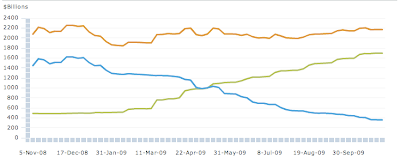
The downtrend in the size of the Fed's special liquidity facilities reflects the easing of the most acute phase of the seizing up of credit market conditions late last year, and, therefore, the quiet winding down of programs like the TAF (Term Auction Facility), the Primary Dealer Credit Facility, the Commercial Paper Funding Facility, etc. However, this trend has been fully offset by the Fed;s stepping up of two key programs of purchasing securities outright: $300 billion of Treasuries (the program was just completed at the end of October), and the still ongoing massive program to purchase a total of $1.25 trillion of agency mortgage-backed securities and $175 billion of agency debt (both of which are expected to be completed by the end of the first quarter of 2010). The net result of that shift among the Fed's various programs has had no discernible effect on the total size of the central bank's balance sheet, which actually remains in the vicinity of $2.2 trillion- essentially close to its peak reached since the fourth quarter of 2008.
The injection of that liquidity has been delivered via a combination of a number of special lending facilities and outright purchases of different kinds of securities. While in the early phase of such liquidity injections, the vehicle of choice was mostly the array of special lending facilities established by the Fed late last year and early 2009, in the last seven months or so, the mix has shifted heavily away from such programs and in favor of outright purchases of securities. As of November 4, 2009, approximately 75% of the Fed's total balance sheet consisted of securities held outright (vs. about 1/3 in March), while the remaining 25% consisted of the various special liquidity facilities.


The downtrend in the size of the Fed's special liquidity facilities reflects the easing of the most acute phase of the seizing up of credit market conditions late last year, and, therefore, the quiet winding down of programs like the TAF (Term Auction Facility), the Primary Dealer Credit Facility, the Commercial Paper Funding Facility, etc. However, this trend has been fully offset by the Fed;s stepping up of two key programs of purchasing securities outright: $300 billion of Treasuries (the program was just completed at the end of October), and the still ongoing massive program to purchase a total of $1.25 trillion of agency mortgage-backed securities and $175 billion of agency debt (both of which are expected to be completed by the end of the first quarter of 2010). The net result of that shift among the Fed's various programs has had no discernible effect on the total size of the central bank's balance sheet, which actually remains in the vicinity of $2.2 trillion- essentially close to its peak reached since the fourth quarter of 2008.
The gradual winding down of the special liquidity facilities can, on the face of it, be viewed as a positive development, reflecting the relative restoration of normalcy in credit market conditions. However, this is the easier part of the Fed's challenge ahead to ultimately withdraw the massive amount of liquidity injected into the financial system during the peak of the crisis. The tougher part of the Fed's job is still ahead, which remains the eventual unwinding of a portfolio of holdings consisting, to a very considerable degree, of mortgage-backed and other non-Treasury securities.
With the mortgage-backed securities market still scarred by its near-apocalyptic experience of the last two years, the Fed's hands are tied in terms of its ability to resell those securities back into the market any time soon. So, the stage is set for the Fed to remain the proud owner of well over a trillion of low-quality securities over an extended period, mostly counting on the slow runoff of these holdings over a multi-year horizon.
As a result, when the time comes for the Fed to move decisively to start draining the excess liquidity, actively dumping its bloated portfolio of outright holding is unlikely to be a viable component of its exit strategy. Instead, in implementing the latter, the emphasis will need to be more on both conventional (reverse Repurchase Agreements) and more recently introduced tools (interest paid on bank reserves).
Anthony Karydakis
Subscribe to:
Posts (Atom)
